"Phase change material" sounds like something only a packaging engineer would specify. But if you ship perishable food or temperature-sensitive drugs, you almost certainly use it already. Every frozen cold pack in your pack-out does its job by changing phase.
So what is phase change material, and why do suppliers talk about "PCM packs" as if they were their own category? The term covers any material that absorbs or releases heat while it melts or freezes. That includes plain water.
For a shipper, the label on the pack matters less than the fit. The pack's melting point, the amount of material, the insulation and the transit time all have to line up with the range printed on your product. This guide explains how phase change works, where water fits in, and how to choose a set point you can back up with testing.
What is phase change material?
A phase change material (PCM) is a substance that absorbs or releases a large amount of heat while it changes state, usually between solid and liquid, at a nearly constant temperature. In a cold chain pack-out, a frozen PCM pack absorbs heat from the shipment as it melts, holding the contents close to its melting point.
The heat a material absorbs while melting is called its latent heat of fusion. In simple terms:
Heat a pack can absorb while melting = mass of the material × its latent heat of fusion
Two things decide how useful that is in a box. The melting point, often called the set point, decides which temperature the pack holds. The mass decides how long it can hold it before the last of the solid is gone.
How do phase change materials work in a shipping box?
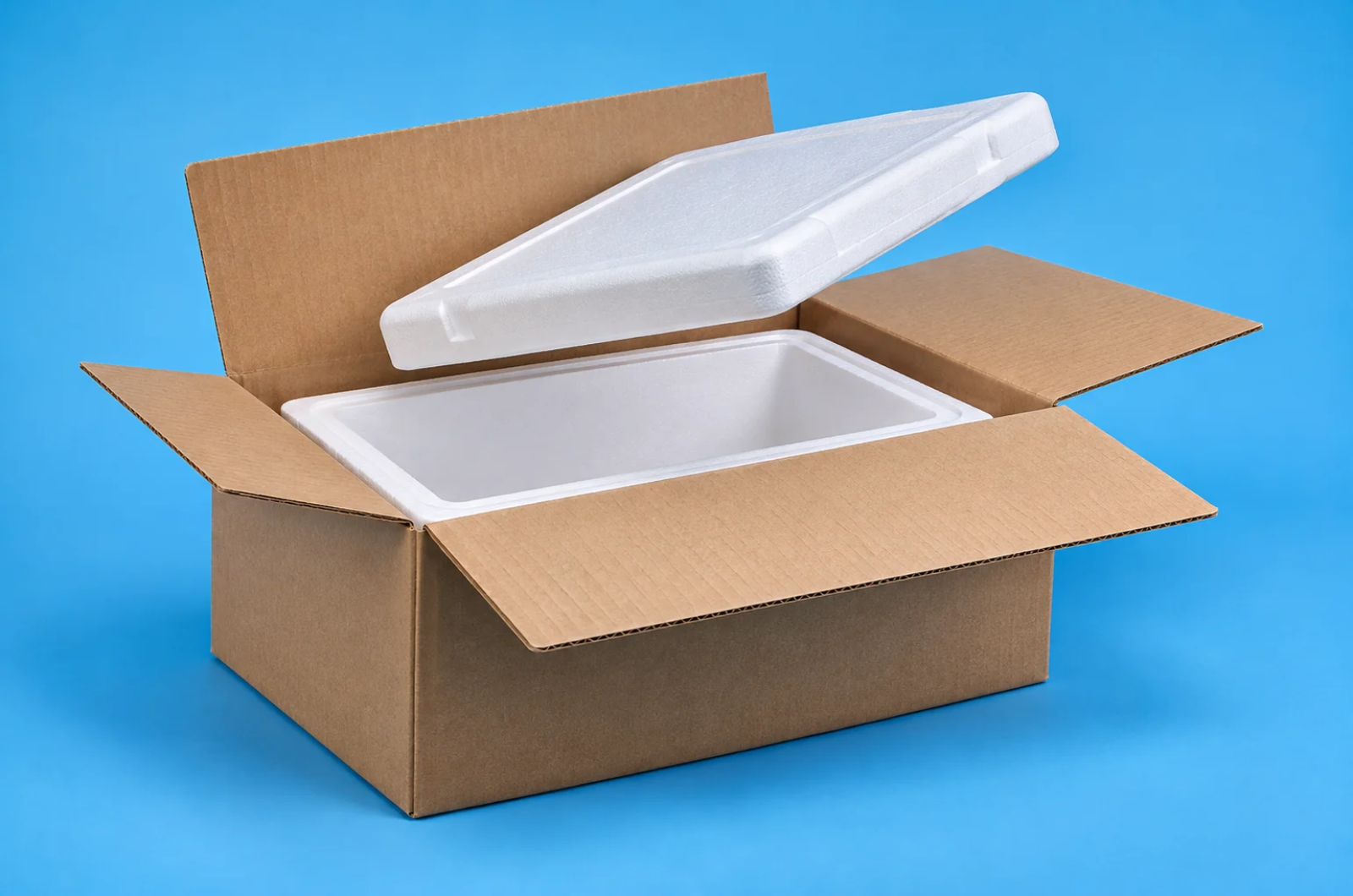
Phase change materials work by soaking up the heat that leaks into a box without getting warmer, as long as some solid is left to melt. Insulation slows that heat down. The PCM absorbs what still gets through.
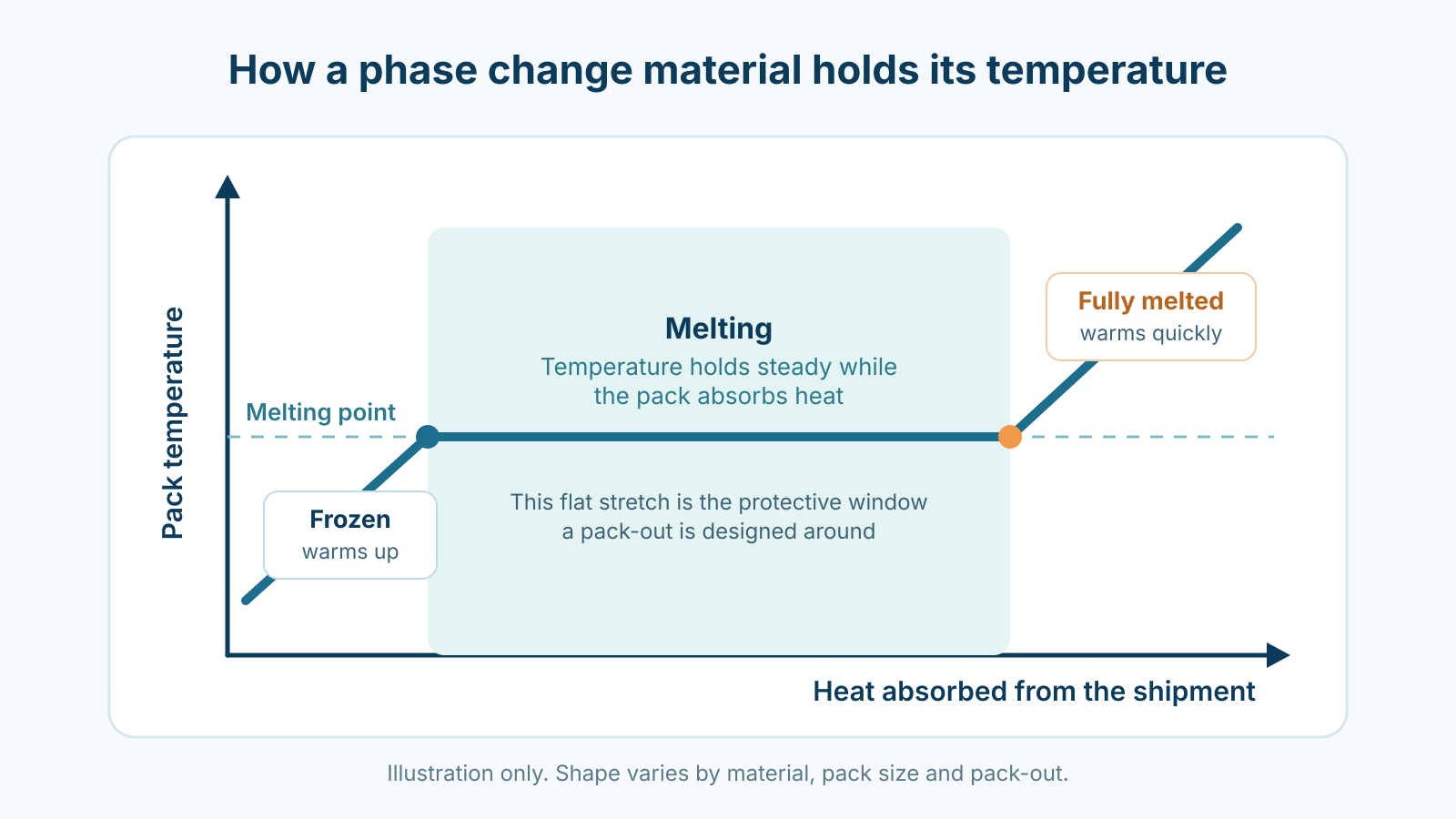
A frozen pack goes through three stages in transit:
- Before melting:
The pack warms from its storage temperature up to its melting point. This is sensible heat, meaning heat you can measure as a temperature rise. - During melting:
The pack absorbs heat while its temperature stays almost flat. OpenStax's physics text puts it plainly: "There is no temperature change until a phase change is completed." See OpenStax's explanation of phase change and latent heat. - After melting:
Once the pack is fully liquid, it warms quickly, and so does everything around it.
That flat middle stretch is the protective window a pack-out is built around. How long it lasts depends on the pack mass, the insulation, the box size and the outside temperature along the route. Our guide on how long ice packs stay cold in a shipping box walks through how to measure it for your own lanes.
Is water a phase change material?
Yes. Water is the most familiar phase change material there is. It melts at 0°C (32°F), and OpenStax lists its latent heat of fusion at 334 kJ per kilogram. A frozen water ice pack is a PCM pack with a 0°C set point.
This is why the "PCM vs ice pack" framing can mislead buyers. Both work the same way. The real differences are the melting point of the material, how much of it is in the pack, and how it is handled before and after use.
Gel packs are mostly water too, thickened with a gelling agent such as a cellulose ether or a superabsorbent polymer. Many also contain a freeze point depressant, such as a salt or a glycol, so the pack stays flexible when cold. That can move the pack's phase change below 0°C and changes how it feels and handles. See ChemPoint's overview of gel pack ingredients. Whether any of it changes performance in your box is a question for testing, not for the product name.
What are the main types of phase change materials?
Phase change materials used in packaging fall into a few broad families. The U.S. Department of Energy groups common PCMs as organic or inorganic, with paraffins as typical organics and salt hydrates as typical inorganics. See the Department of Energy's webinar on novel thermal energy storage materials.
- Water and water-based gel packs:
Packs filled only with water change phase at 0°C (32°F) and can be drained after use, with the film handled under local waste guidelines. Gel packs are mostly water, but added freeze point depressants can lower their phase change temperature. - Salt hydrates:
Inorganic salts combined with water. They can be formulated to change phase at temperatures other than water's. - Paraffins and other organics:
Waxy hydrocarbons and fatty acids, selected for a melting point within a target range. - Bio-based materials:
Newer plant- or protein-derived materials that are still largely at the research stage.
Dry ice is sometimes grouped with these, but it turns straight from solid to gas instead of melting. Our post on dry ice alternatives for shipping covers when shippers move away from it.
No family is right for every shipment. The useful questions are which set point your product needs, how much material the box can hold, and what handling and disposal look like at your volume.
How do you choose the right phase change temperature for your product?
Start from the product's labeled storage range, not from the pack. The set point and conditioning of your phase change packs should keep the product inside that range for the full lane, in every season, and testing should prove it.
1. Start with the label range
Health Canada's guidance says "Drugs must be stored and transported according to labelled storage conditions." For perishable food, the USDA's mail order guidance says food should arrive at or below 40 °F (about 4°C). See Health Canada's guidelines for environmental control of drugs during storage and transportation (GUI-0069) and USDA FSIS guidance on mail order food safety. Other markets set their own rules, so check the regulator where you ship.
2. Profile the lane and the season
GUI-0069 asks shippers to base container choice on "expected extremes of ambient temperature based on lane/route profiling" and to consider seasonal extremes. A set point that holds in spring can fall short in a summer heat wave or a winter cold snap.
3. Match the set point and plan conditioning
Conditioning means bringing a pack to a defined temperature before it goes in the box. In the US, the CDC's guidance on non-emergency vaccine transport lists conditioned frozen water bottles and PCMs conditioned between 4°C and 5°C (39°F and 41°F) as coolants for refrigerated vaccines. Your own product and lane decide which approach fits.
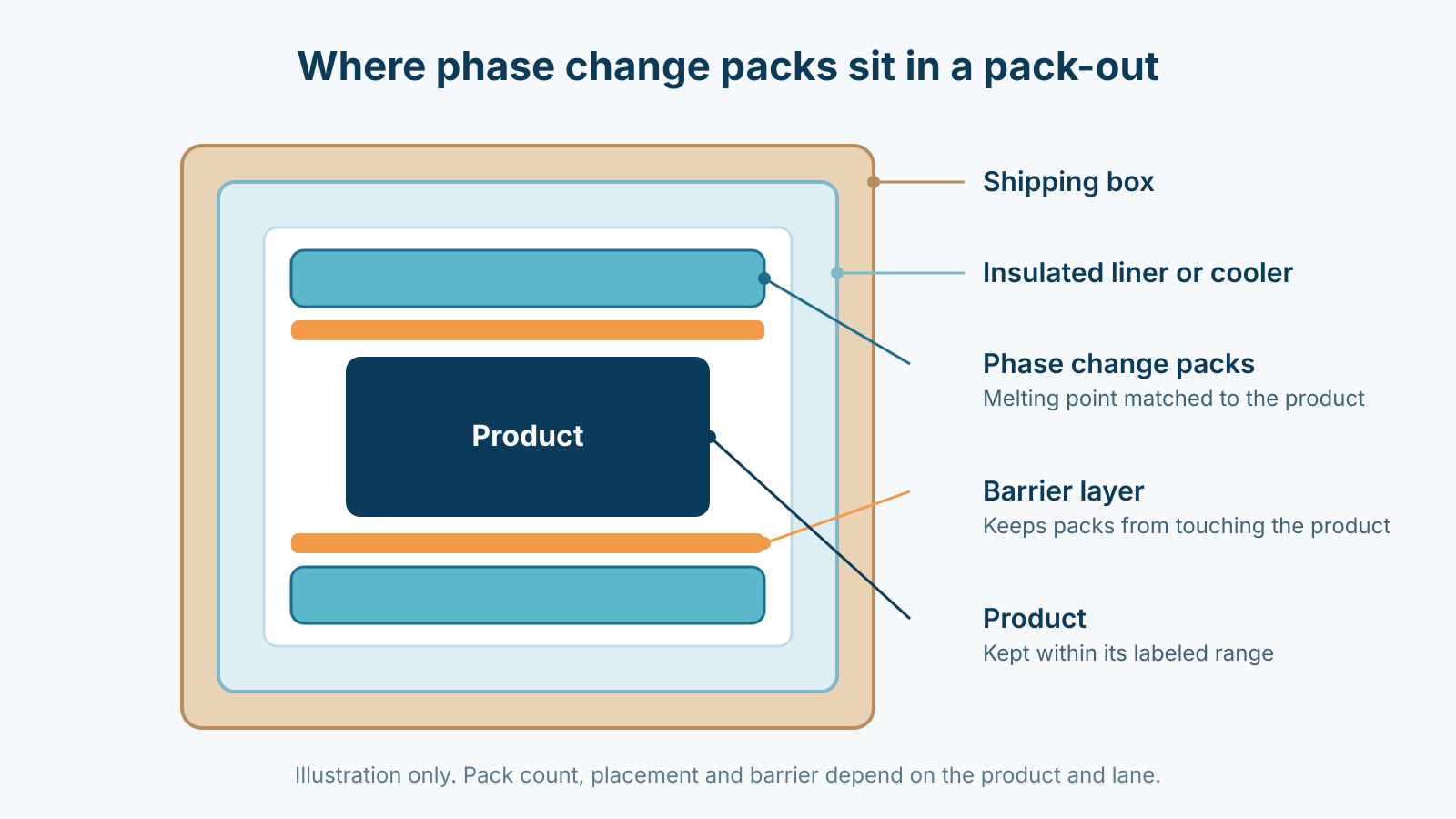
4. Keep coolant and product apart
GUI-0069 calls for "enough barrier materials" to prevent contact between packs and products, and the CDC suggests an insulating barrier such as bubble wrap. A barrier keeps the coldest surface in the box away from anything that should not freeze.
5. Size the pack count to the lane
GUI-0069 says "the type, size and number of packs" should correspond to the shipping time and temperature requirements. Longer lanes and hotter seasons need more phase change capacity, smarter placement, or better insulation.
6. Test the whole pack-out
ISTA describes its 7E standard as a "Testing Standard for Thermal Transport Packaging Used in Parcel Delivery System Shipment," and Standard 20 as a design and qualification process for insulated shipping containers. See ISTA's thermal standards. For drugs shipped direct to patients, our page on direct-to-patient pharmaceutical cold chain covers the pack-out side.
Do PCM packs cool better than gel or water ice packs?
Not automatically. A pack's cooling comes mostly from the heat its material absorbs while it melts, so performance depends on the set point, the mass and the pack-out, not on whether the pack is called PCM, gel or ice.
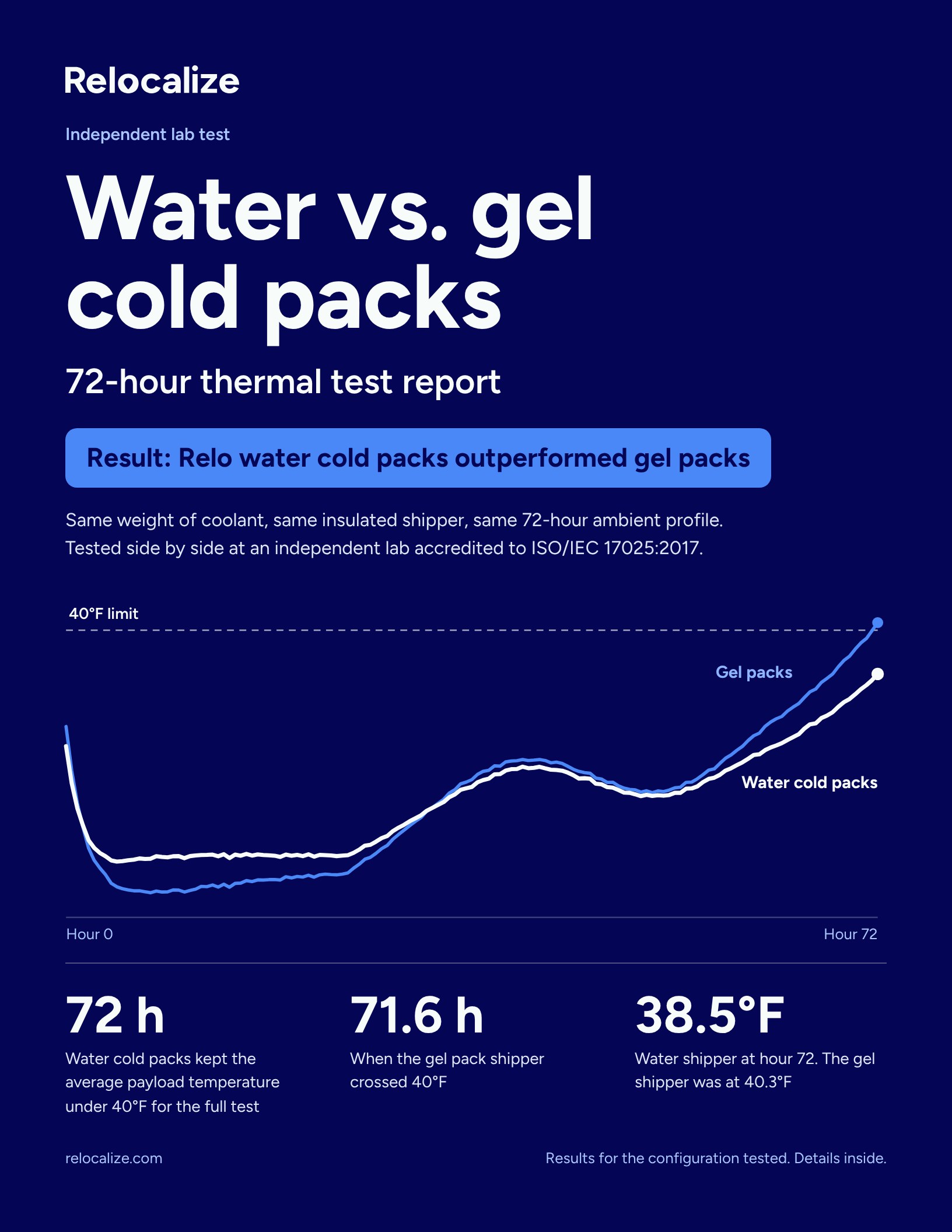
Gel is not automatically superior either, because the water does the cooling. In one specific 72-hour test configuration in meal kit packaging, Relocalize water packs stayed within the protective temperature window longer than conventional gel packs before crossing 4°C (39°F). An A2LA-accredited laboratory ran the test under ISO/IEC 17025:2017. That result covers that test setup, so test your own pack-out before you switch.
You can request the full lab report, with the temperature data, here.
Questions to ask your cold pack supplier about phase change
Use these questions whatever material you are considering:
- What is the pack's phase change temperature, and how was it measured?
- What is the fill material, and what disposal guidance applies in the markets I ship to?
- How should packs be conditioned before packing, and for how long?
- Which pack weights, dimensions and formats fit my box without empty space?
- Has the pack been tested in a pack-out like mine, using ISTA 7E profiles or equivalent?
- How are packs delivered, and how much freezer space will I need on site?
- What happens to lead times if my volume jumps?
The hidden cost: where your phase change packs come from
Most phase change packs used for chilled and frozen shipping have to be frozen or conditioned before they go in a box. So the pack you buy is only part of the cost. Freezing capacity, frozen storage and frozen transport make up the rest.
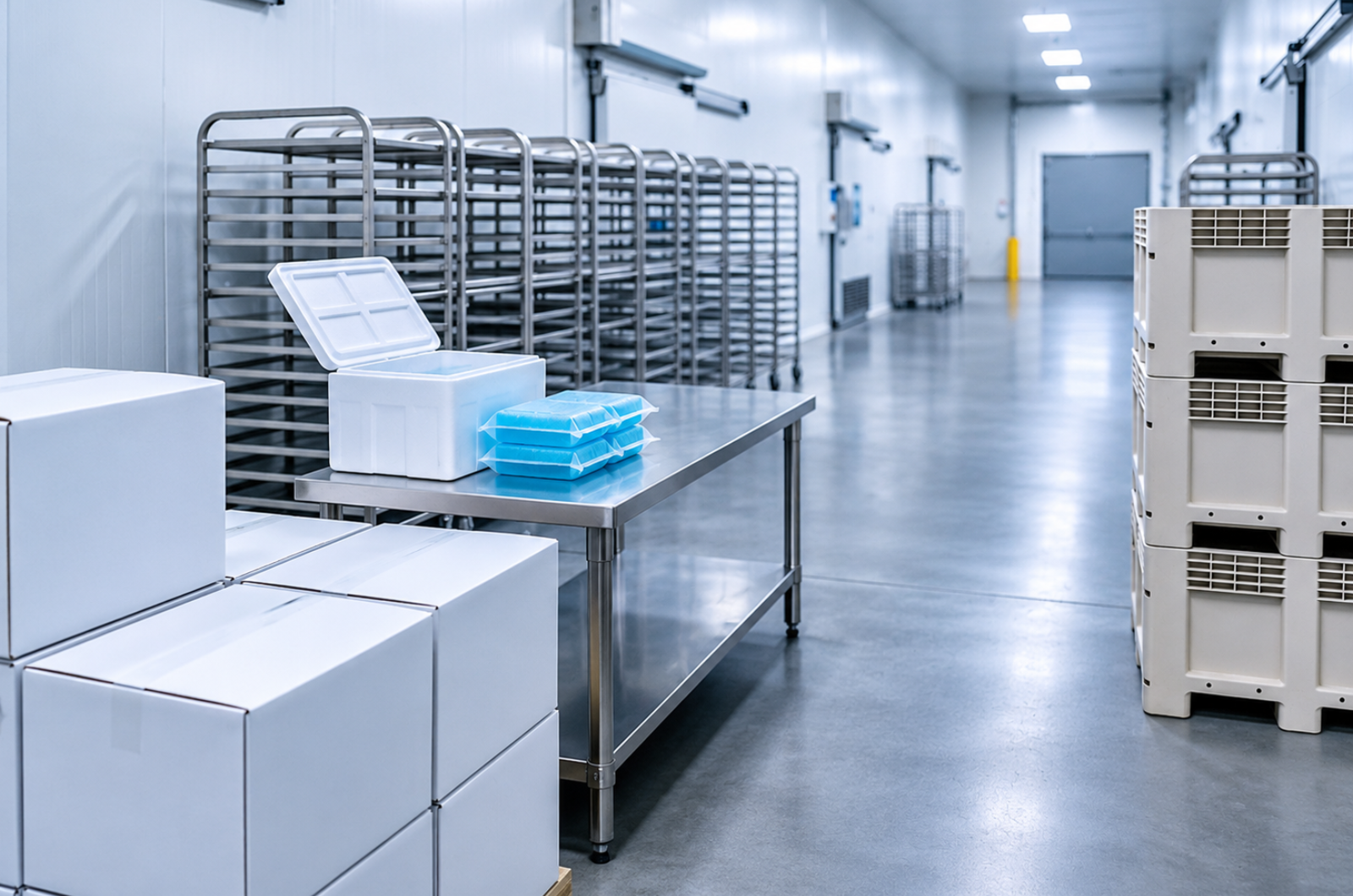
In a conventional setup, packs can be made in one place, frozen in a refrigerated warehouse, then trucked frozen to the fulfillment center. Each step adds handling, cold storage and lead time, and fulfillment centers usually have little room to hold extra stock.

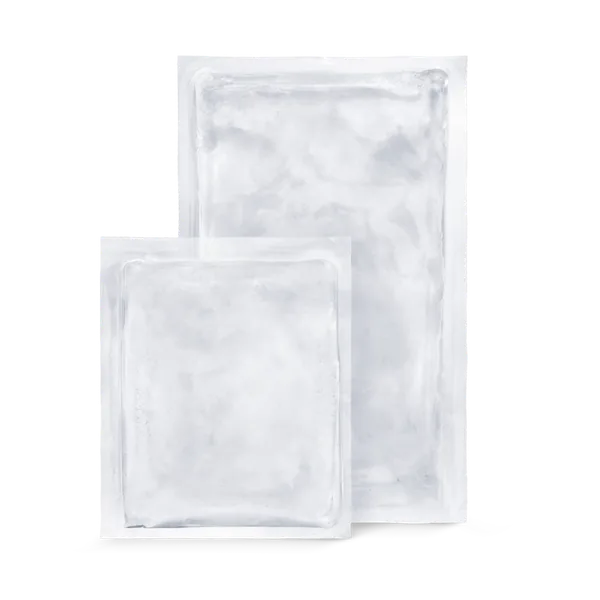
Relocalize makes cold packs from 100% water, with no gel, additives or colouring, sealed in food-grade film. Because the fill is only water, the pack changes phase at water's melting point, 0°C (32°F). Weights, dimensions, formats and private-label printing can be customized, which helps for meal kits and food fulfillment as well as pharma.
For qualifying high-volume operations, an on-site autonomous micro-factory can produce, freeze and palletize packs at or near the fulfillment center. That reduces long-distance frozen-pack transport, cold storage transfers, buffer inventory and supplier lead times. Relocalize manages installation, monitoring, maintenance and production support, and works with a network of cold chain packaging partners on boxes, liners and pack-out configurations.
Phase change material: the takeaway
So, what is phase change material in practice? It is whatever melts inside your box to absorb heat, from engineered salt hydrates and paraffins to plain water. The name on the pack matters less than its set point, its mass and how it is conditioned, placed and tested in your pack-out.
If you are reviewing your coolant, start with the product label, profile your lanes, and test before you switch. To talk through cold packs for your operation, see our cold packs page or get in touch.
Frequently asked questions
What is phase change material in simple terms?
A phase change material is anything that absorbs a lot of heat while it melts, while its own temperature barely changes. In shipping, a frozen PCM pack melts slowly inside the box, soaking up heat that leaks in and holding the contents near the pack's melting point until the solid is gone.
Is an ice pack a phase change material?
Yes. Water is a phase change material that melts at 0°C (32°F), so a frozen water ice pack is a PCM pack with a 0°C set point. The difference between ice packs and engineered PCM packs is the melting temperature and fill material, not the way they cool.
How do phase change materials work in shipping?
Insulation slows the heat entering a box, and the phase change material absorbs the heat that gets through. While the material melts, its temperature stays nearly flat, which keeps the product close to that temperature. Once the material is fully melted, the box warms much faster.
What are the main types of phase change materials?
The common families are water-based packs, salt hydrates, and organic materials such as paraffins and fatty acids, with bio-based materials still emerging. Each can be chosen or formulated for a melting point. The right choice depends on your product's labeled range, your lanes and how packs are handled.
Are PCM packs better than gel packs?
Not by default. Gel packs, ice packs and engineered PCM packs all cool by absorbing heat from the box, much of it as their frozen contents melt. Which one performs better depends on the set point, the amount of material and the pack-out, so compare them in a test that matches your box, product and route.
Do phase change material packs need to be frozen before use?
Most packs for chilled and frozen shipments must be frozen or conditioned to a set temperature before packing. Conditioning steps and times vary by material and product, so follow your supplier's guidance and validate the full pack-out, including conditioning, in testing.