Many shippers use dry ice out of habit. It is the refrigerant most people picture for frozen food and medicine, and it is often already written into the pack-out spec when a new operations manager takes over. But dry ice brings hazardous materials rules, extra handling steps and a refrigerant that turns into gas during transit.
If you are evaluating a dry ice alternative, the first question is not which refrigerant is coldest. It is what temperature your product needs to arrive at, and for how long. Many shipments packed with dry ice only need to stay refrigerated or arrive partially frozen, and that opens the door to other options.
The right answer depends on the whole pack-out: the product's temperature range, the transit time, the outside temperatures on your lanes, the insulation, and how the refrigerant is conditioned and placed. Change one of those and the result changes.
What Is the Best Dry Ice Alternative for Shipping?
For most chilled shipments, the most practical dry ice alternative is a frozen cold pack, either water or gel, sized and placed for your lanes. For products that must stay deeply frozen, sub-zero phase change materials or powered refrigeration are the usual options. Whatever you choose, confirm it with a pack-out test.
Refrigerant choice = product temperature range + transit time + outside temperatures + insulation + refrigerant placement
Why Do Shippers Look for Dry Ice Alternatives?
Shippers usually look for alternatives because dry ice adds rules, handling steps and costs that the product itself may not need. These are the main pressure points.
- Air transport rules:
In the US, dry ice is regulated as a hazardous material when it travels by air. See the FAA's dry ice fact sheet for shippers, which explains that packages must let carbon dioxide gas escape and that more than 2.5 kg (5.5 lb) per package requires hazmat training, extra markings and labels. - Packaging and marking:
Under 49 CFR 173.217, dry ice packaging for air or water transport must be "designed and constructed to permit the release of carbon dioxide gas," and smaller packages still need to be marked with the contents and the net weight of the dry ice. - Carrier procedures:
FedEx's guidance on shipping dry ice asks for "UN 1845" markings and a Class 9 hazard label on air packages, and asks shippers to mark ground packages "Dry Ice" as well. It also suggests planning 5 to 10 pounds of dry ice for every 24 hours in transit, plus enough for an extra 24 hours of delay. - Handling safety:
Dry ice is solid carbon dioxide. The NIOSH Pocket Guide entry for carbon dioxide lists it as subliming (turning directly from solid to gas) at −109°F (about −78°C) and sets workplace exposure limits for the gas. USDA also advises recipients not to touch dry ice with bare hands. - Supply and timing:
Because dry ice keeps turning into gas from the moment it is made, it has to be bought, stored and packed on a tight schedule.
These are US rules. Other countries and carriers apply their own dangerous goods requirements to dry ice, so check the rules for each market you ship to.

Do Frozen Products Always Need Dry Ice?
No. Dry ice is common for frozen goods, but US food safety guidance focuses on the temperature food arrives at, not on which refrigerant gets it there. USDA's guidance on sending and receiving mail-order food says perishable food "should arrive frozen or partially frozen with ice crystals still visible or at least refrigerator cold," below 40°F (4°C), and should not be used if it arrives warmer than that.
So the real question is your product's own specification:
- Products that must stay hard frozen:
Ice cream and other items with a stated sub-zero storage range are typically shipped with dry ice or with phase change materials designed to hold temperatures below 0°C (32°F). - Products that can arrive partially frozen or refrigerated:
Depending on the brand's specification, this can include some frozen meats, prepared meals and meal kit components. - Chilled products:
Fresh food, many beverages and many refrigerated medicines need to stay cold, not frozen, and very cold refrigerants placed too close can freeze them. FedEx's perishables packaging guide recommends gel coolants for products between 32°F (0°C) and 60°F (16°C).
Carrier guidance matters too. The same FedEx guide points frozen products to dry ice, so confirm what your carrier expects before you change refrigerants. Carriers in other markets set their own requirements.
What Can You Use Instead of Dry Ice?
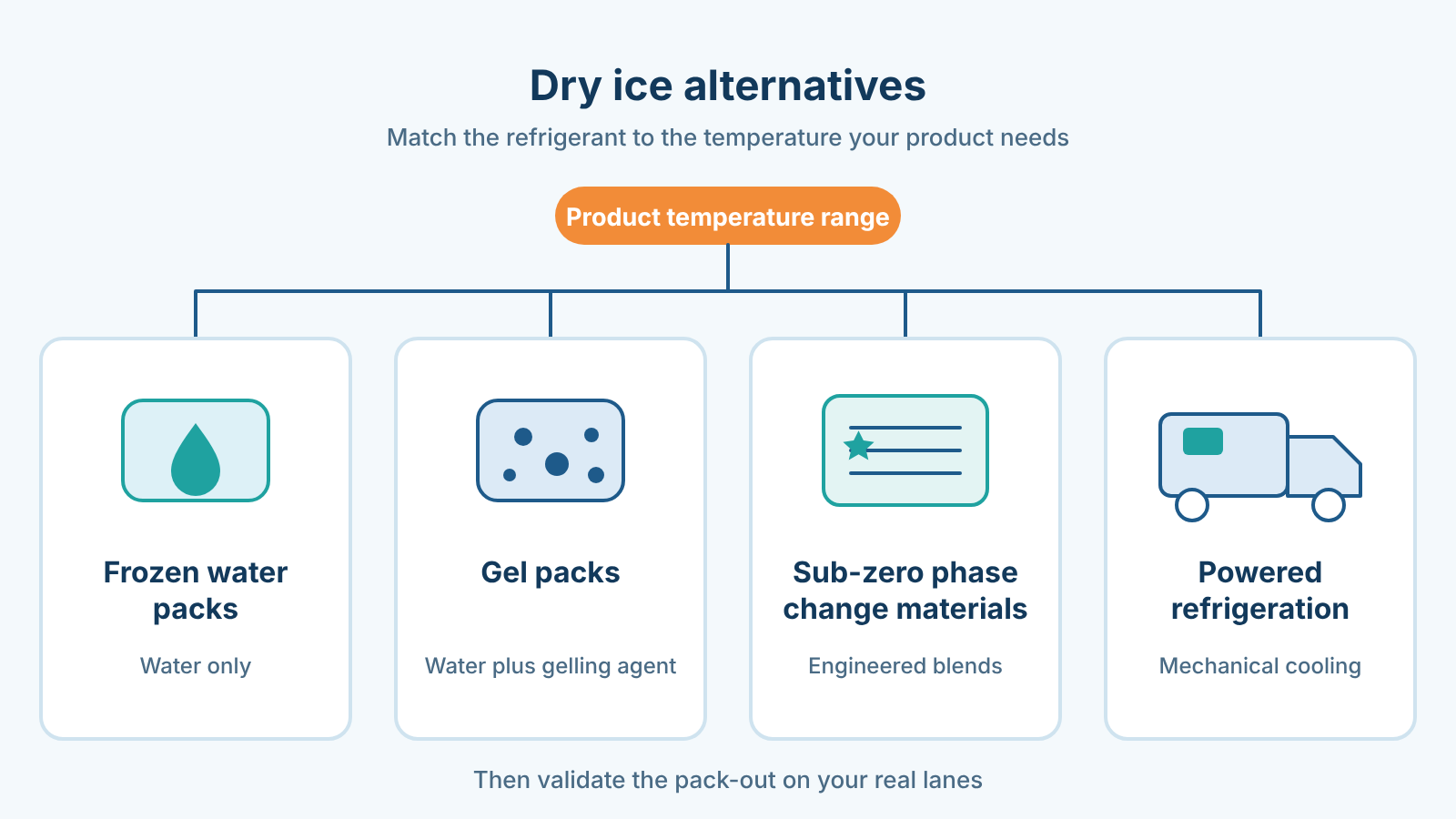
The main alternatives are frozen water packs, gel packs, sub-zero phase change materials and powered refrigeration. Each one works around a different temperature point, which is why matching the refrigerant to the product matters more than picking the coldest option.
- Frozen water cold packs:
Sealed packs of water, frozen before use. Water absorbs a large amount of heat as it melts at 0°C (32°F), which makes it a natural fit for keeping chilled products cold. Water packs are not subject to the dry ice rules above, and the contents can be drained after use. - Gel packs:
Packs of water mixed with a gelling agent. They are widely used for chilled shipments, and disposal rules vary by formulation. See our guide on how to dispose of gel packs. - Sub-zero phase change materials:
A phase change material (PCM) stores and releases heat as it changes between solid and liquid at a set temperature. Formulations that change phase below 0°C (32°F) are used where products must stay frozen, and they typically need careful conditioning in freezers before packing. - Powered refrigeration:
Refrigerated trucks and powered containers hold temperature mechanically. They suit pallet and route-based deliveries more than individual parcels.
For a fuller comparison of refrigerant types, see our buyer's guide to types of cold packs for shipping.
Is Gel Better Than Water for Cooling?
Gel is not automatically better for cooling. In both gel and water packs, it is the water that does the cooling as it melts, so the gelling agent alone does not make a pack colder or longer lasting.
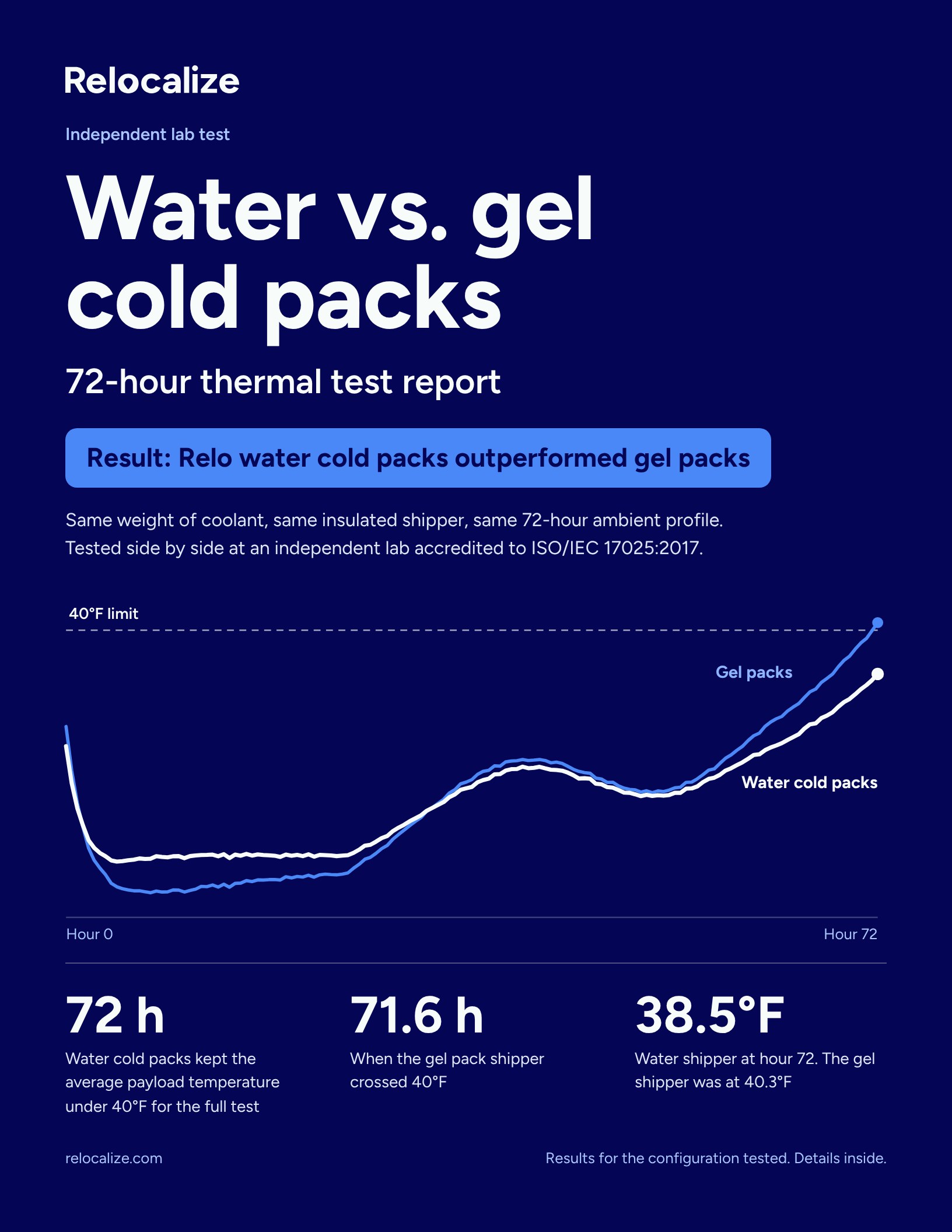
In one specific 72-hour test configuration in meal kit packaging, Relocalize water packs stayed within the protective temperature window longer than conventional gel packs before crossing 4°C (39°F). Testing was done by an A2LA-accredited laboratory under ISO/IEC 17025:2017. The result applies to that test configuration, so your own products and lanes still need testing.
You can request the full lab report, with the temperature data, here.
How to Switch From Dry Ice: A 6-Step Pack-Out Test
Switching refrigerants is a pack-out change, so treat it as a small validation project rather than a simple supplier swap.
1. Confirm the required temperature range
Write down the range your product must stay within and the condition it must arrive in: frozen, partially frozen or refrigerated. Use the brand, manufacturer or regulatory specification, not habit.
2. Map your lanes and seasons
List transit times, including weekend and delay scenarios, and the outside temperatures on each lane. ISTA 7E provides summer and winter temperature profiles built from real parcel shipments over 72-hour and 144-hour durations.
3. Choose the refrigerant and its conditioning
Pick the refrigerant whose working temperature matches your range. Define how long packs are frozen or conditioned, and at what freezer temperature, so every pack starts the same way.
4. Build the pack-out
Decide pack weight, count and placement around the product, and how packs sit against the liner. Flat, consistent packs make placement easier to repeat on a busy line.
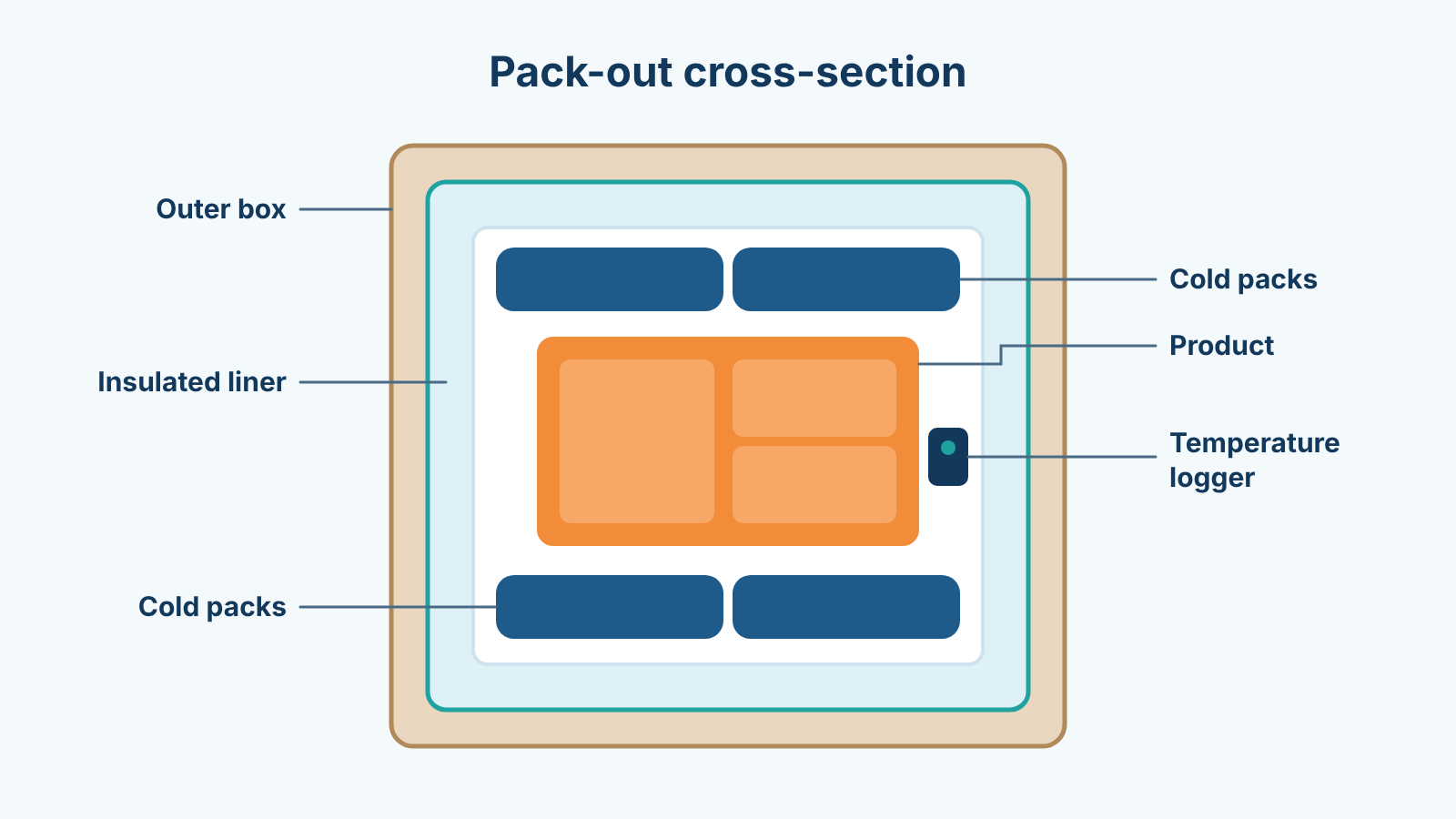
5. Test with temperature loggers
Run the pack-out through chamber tests or real shipments with data loggers, at both seasonal extremes. Record how long the product stays within range, not just its arrival temperature.
6. Roll out and monitor
Phase the change in by lane or season. Keep logging a sample of shipments and review any temperature excursions (periods outside the required range) and customer complaints.
Questions to Ask Your Cold Pack Supplier
Before you replace dry ice, these questions help you compare suppliers on the details that affect your line.
- What is in the pack, and how should customers dispose of it?
- Which weights, dimensions and formats can you produce to fit our box?
- Can you print our branding or handling instructions on the film?
- How are packs delivered, and how much freezer space do they need?
- Have your packs been tested in a configuration similar to ours, and can we see the data?
- What lead times and minimum volumes apply, and how do you handle demand spikes?
The Hidden Cost of Dry Ice and Conventional Cold Pack Supply
The refrigerant line on an invoice rarely shows the full cost of dry ice. The rest sits in operations: trained staff for air shipments, marking and labeling, ventilated storage, tight purchasing schedules and customer questions about handling it at home.
Conventional frozen cold pack supply has hidden costs too, mostly long-distance frozen transport from the supplier's plant, cold storage transfers, buffer inventory and supplier lead times.
Relocalize makes 100% water cold packs with no gel, additives or coloring, sealed in food-grade film. Weights, dimensions, formats and private-label printing can be customized to fit your box and pack-out, and we work with a network of cold chain packaging partners on boxes, liners and pack-out configurations.
For qualifying high-volume operations, an on-site autonomous micro-factory can produce, freeze and palletize packs at or near the fulfillment center, reducing long-distance frozen-pack transport, cold storage transfers, buffer inventory and supplier lead times. Relocalize manages installation, monitoring, maintenance and production support, so you do not buy or operate your own production line.

Choosing Your Dry Ice Alternative
The best dry ice alternative is the one that keeps your product within its specified range across your real lanes, with the least handling and compliance burden. Start from the product's temperature requirement, match the refrigerant to it, then prove the pack-out with testing before you roll it out.
To explore water cold packs for your operation, see Relocalize cold packs and our cold packs for meal kits and food fulfillment, or get in touch to talk through your pack-out.
Frequently Asked Questions
What is a good dry ice alternative for shipping food?
For chilled food, frozen water packs or gel packs are the most common dry ice alternatives, sized for your transit time and outside temperatures. For food that must arrive frozen, check the product specification and your carrier's guidance, and test any new pack-out before switching.
Is dry ice a hazardous material?
In the US, dry ice is regulated as a hazardous material when shipped by air, with venting, marking and quantity rules under 49 CFR 173.217. The FAA notes it is not regulated as a dangerous good for ground transport, although carriers may still require markings. Other countries set their own rules.
Can I use ice packs instead of dry ice?
Often, yes, when the product needs to stay refrigerated or arrive partially frozen. Frozen ice packs work around 0°C (32°F) as they melt, so pack count, placement and insulation need to match your transit time. Confirm the result with a pack-out test on your own lanes.
What is the difference between dry ice and gel packs?
Dry ice is solid carbon dioxide that turns directly into gas at about −78°C (−109°F) and is regulated for air transport. Gel packs are water-based packs with a gelling agent that cool as the water melts near 0°C (32°F), and their disposal rules vary by formulation.
How much dry ice do I need for shipping?
It depends on the insulation, the transit time and the outside temperature. FedEx suggests planning 5 to 10 pounds of dry ice for every 24 hours in transit, plus enough for an extra 24 hours of delay. A pack-out test gives the real answer for your shipment.
Do I need special packaging for dry ice?
Yes. Dry ice packaging must let carbon dioxide gas escape, so it should never be sealed airtight. FedEx advises against airtight containers and sealed plastic bags for dry ice, and air shipments need specific markings such as the dry ice weight and, above 2.5 kg (5.5 lb), hazard labels.