Searching for cold chain packaging usually starts with a specific problem: a box that arrives warm in July, a quote that jumped, or a sustainability target a foam cooler no longer meets. The temptation is to compare products one at a time and pick the cheapest box or the thickest liner.
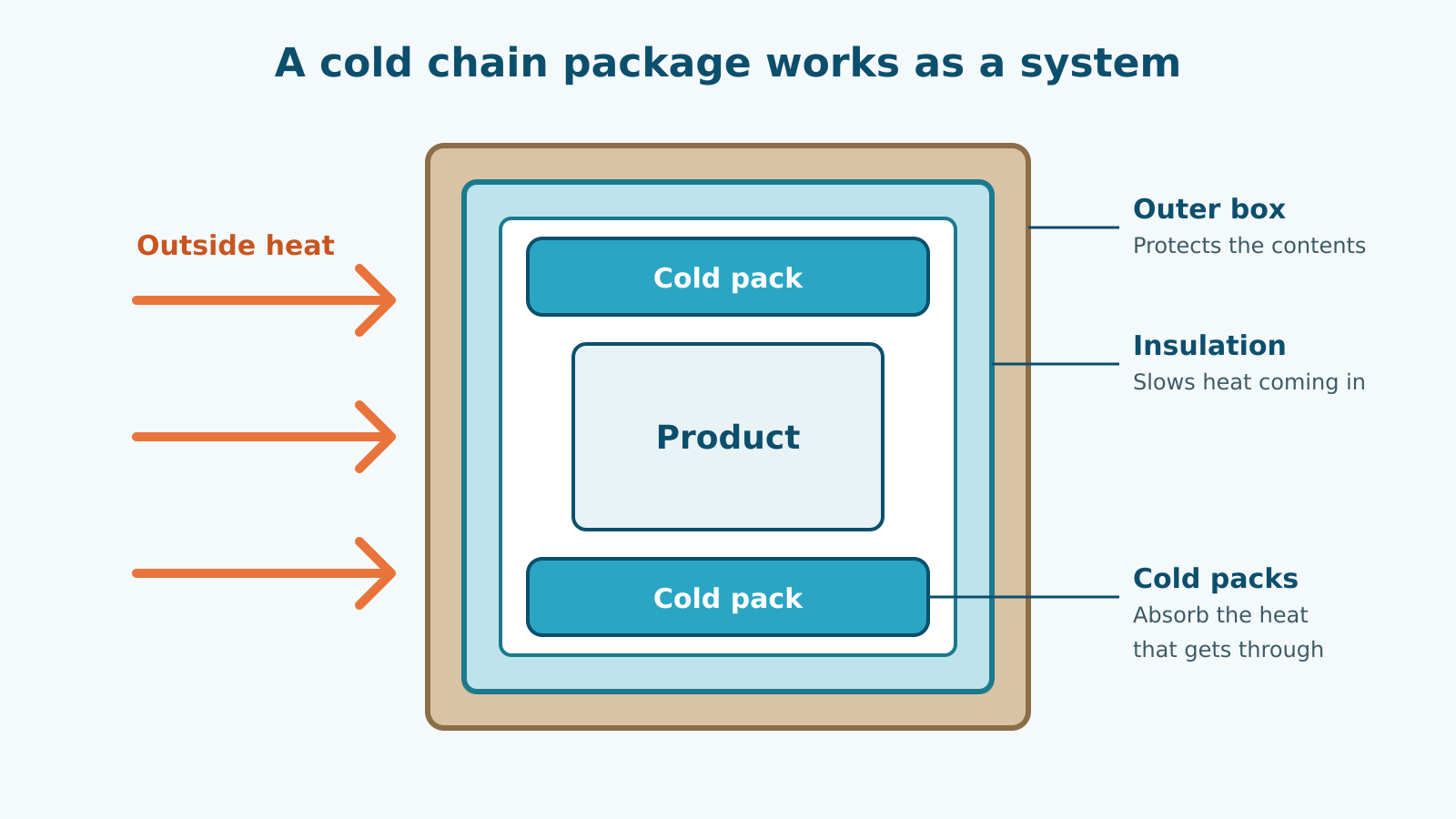
That approach misses how thermal packaging works. A package holds temperature as a system: the box, the insulation, the cold packs, how they are arranged and the route all shape the result. Change one part and the others may need to change too.
This guide gives you a six-step way to choose, the materials and refrigerants worth comparing, and the questions to put to any supplier.
How Do You Choose Cold Chain Packaging?
Start with the temperature your product needs and how long it must stay there, then map your lanes and seasons. Choose the box, insulation and cold packs as one system, check that it fits your pack line, and test the full pack-out before you commit.
Right packaging = product temperature range + transit time + outside conditions + box and insulation + cold packs
Every product and lane is different, so treat any supplier's performance claim as a starting point and validate it in your own conditions.
What Is Cold Chain Packaging?
Cold chain packaging is the set of materials that keeps a temperature-sensitive product within a required range during shipping. This guide focuses on passive packaging, which has no power source and relies on insulation and cold packs. Active cold chain shipping solutions use powered refrigeration.
A pack-out is the exact arrangement of those materials for one product and lane. It usually includes:
- Outer box:
Protects the contents and carries the shipping label. - Insulation:
A liner or cooler that slows heat moving through the box walls. - Cold packs:
The refrigerant that absorbs heat entering the package. - Inner protection:
Liners, absorbent material or bags that contain moisture and keep the product clean.
How to Choose Cold Chain Packaging in Six Steps
Work through these steps in order, because each one narrows the next.
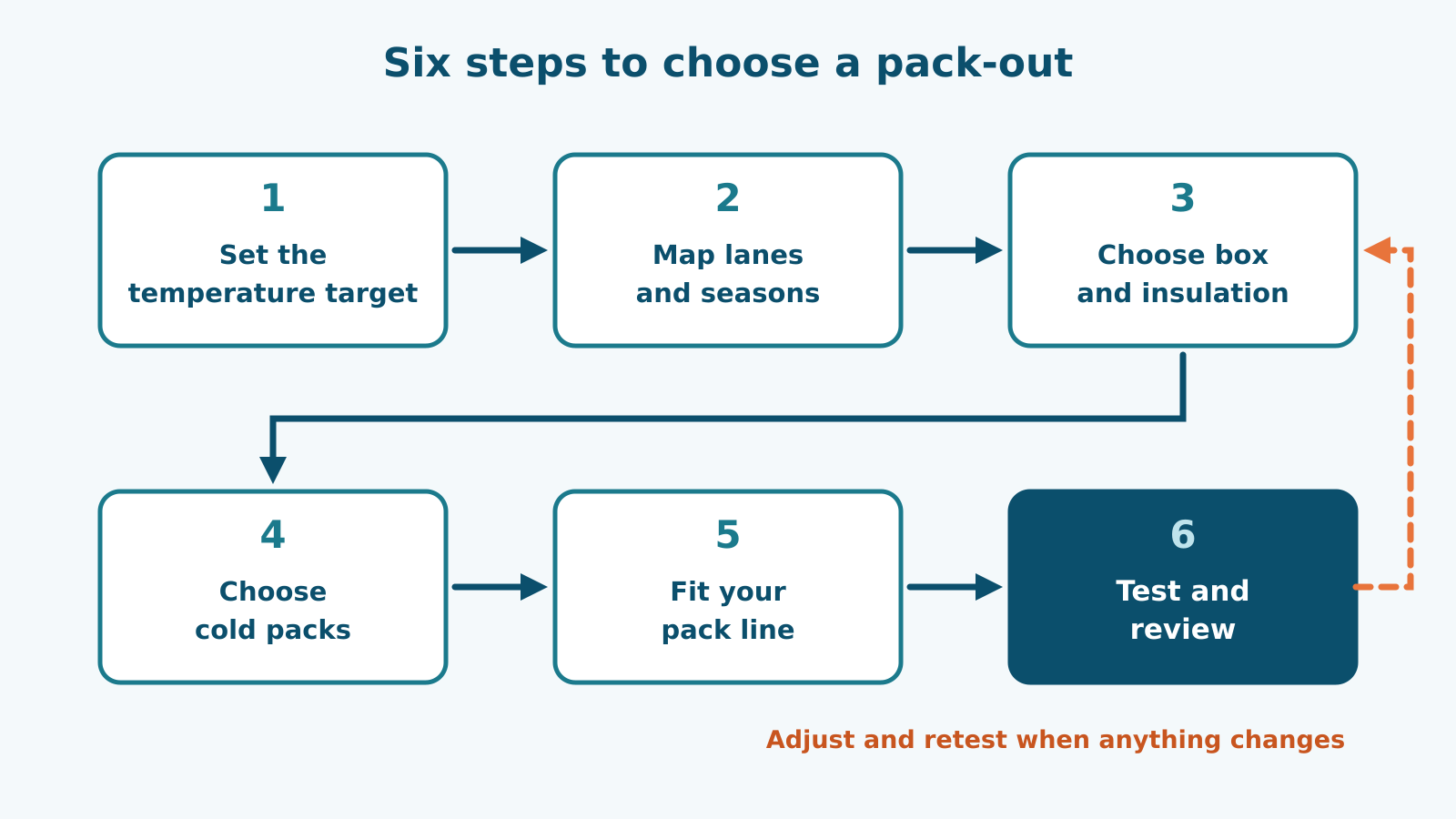
1. Set the temperature target
Write down the range your product must stay within, the limit on either side, and whether freezing is a risk. In the US, USDA guidance says mail-order perishables should arrive frozen or at least refrigerator cold, below 40 °F. Drugs follow their labeled storage conditions.
Responsibility matters too. FDA's Sanitary Transportation rule puts decisions about temperature control mainly on the shipper for food moved by motor or rail vehicle, so check whether it covers your operation. Other markets have their own rules.
2. Map your lanes and seasons
List your longest transit time, weekend holds, and the hottest and coldest places a package will pass through. Health Canada's GUI-0069 guidance for drugs tells shippers to account for expected climate, modes of transport, potential delays and seasonal variations. Food shippers can use the same checklist.
3. Choose the box and insulation
Size the box around the product and the cold packs, since extra empty space can give the packs more air to cool. Then match the cold chain insulation to the transit time you mapped. FedEx's perishable shipping guidance calls for walls at least 1-1/2 inches (3.8 cm) thick if you use a foam container. Our guide to packaging refrigerated food for shipping covers insulation and pack-out layouts in more detail.
4. Choose the cold packs
Match the type, size and number of packs to the transit time and temperature target. Then check the practical details: whether packs lie flat, fit the box without gaps, and leave room for the product.
5. Fit it to your pack line
The best design on paper still has to work at speed. Check how long each box takes to pack, how much freezer and floor space you need, and how packs and liners reach the line. Simple layouts also leave less room for error on a busy shift.

6. Test, then keep reviewing
Test the complete pack-out with real product and real pack-line conditions. For parcel shipments, ISTA's thermal standards include the 7E test, with heat and cold profiles over 72 and 144 hours. Our guide on how long ice packs stay cold in a shipping box walks through a test process.
Drug shippers should expect a higher bar. Health Canada asks shippers to qualify pack-outs for expected temperature extremes when they are the main means of environmental control. In the US, CDC guidance on vaccine transport calls for containers and pack-outs qualified through laboratory testing. Retest whenever a component, lane or season changes.
Which Cold Chain Packaging Materials Should You Compare?
Compare materials on thermal performance, cost, storage space and what happens after delivery. Many cold chain packaging solutions combine several of these, and performance depends on the specific product and thickness, so ask for test data instead of relying on the material type alone.
- Molded foam coolers:
Rigid, widely used and well understood, but bulky to store before use. - Fiber and paper-based liners:
Often chosen for curbside recycling goals. Check performance and local acceptance for each product. - Foil and bubble liners:
Lightweight and compact, with performance that varies by construction. - Reusable containers:
Suit closed loops where the shipper can get the container back.
Materials also affect end-of-life costs. Under extended producer responsibility (EPR), producers carry costs or duties for packaging after use. In the US, California's SB 54 program gives producers primary responsibility for managing products after use. In Canada, Ontario's Blue Box regulation requires producers to operate and pay for collection and recycling. Other markets have their own rules, so check where you sell.
Which Cold Packs Fit Your Pack-Out?
The right cold pack depends on your temperature target, transit time and handling. These are the main options:
- Gel packs:
Pre-filled with a gelling agent and common for chilled shipments. Disposal rules vary by formulation. - Water cold packs:
Filled with water only, so the contents can be drained after use. - Phase change materials:
Engineered packs often used when a product needs a narrow temperature range. - Dry ice:
Used to keep products frozen. FedEx treats it as a hazardous material for air transport, so it brings marking and handling requirements.
Does Gel Cool Better Than Water?
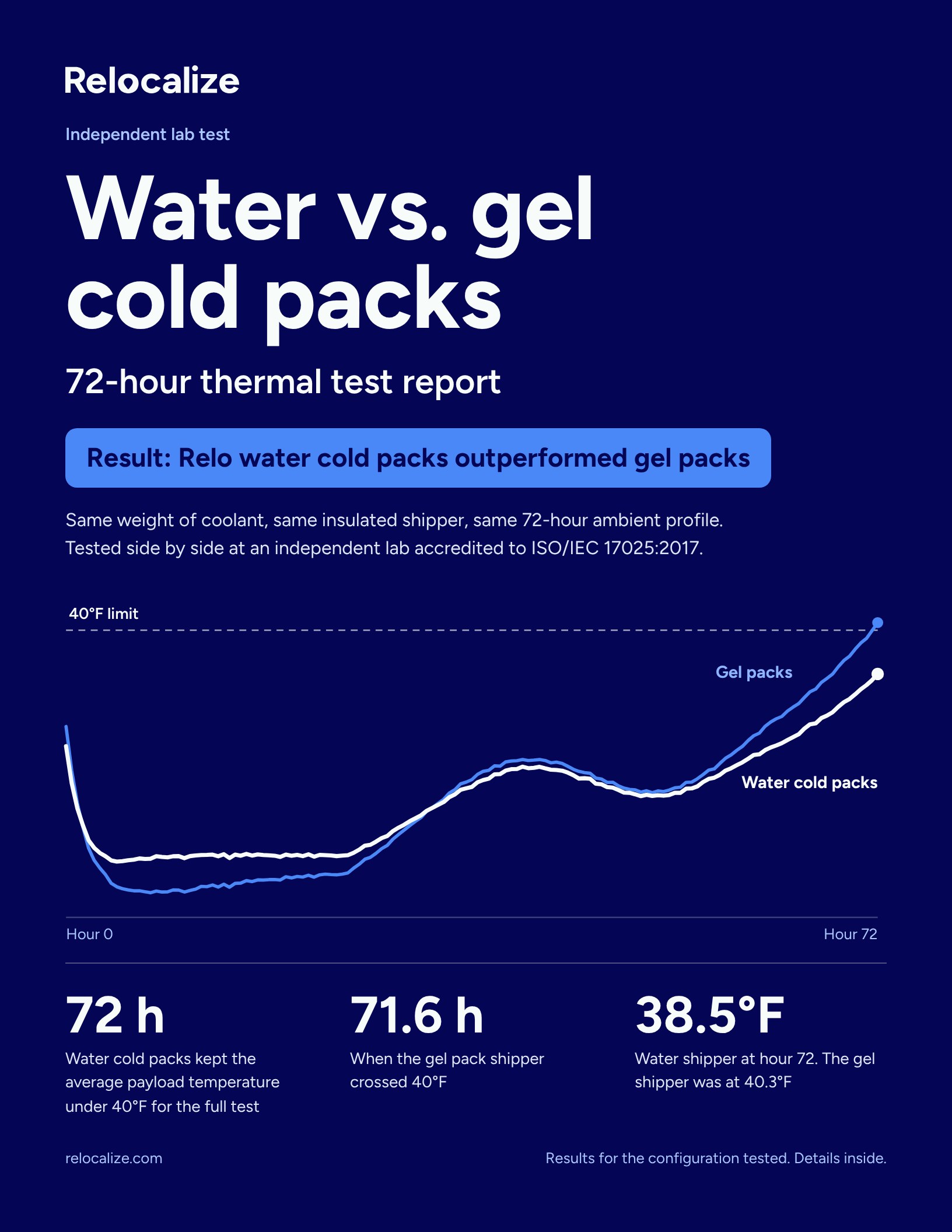
Not automatically. In a typical gel pack, the water does the cooling, so a gelling agent does not by itself make a pack perform better.
In one specific 72-hour test configuration in meal kit packaging, run by an A2LA-accredited laboratory under ISO/IEC 17025:2017, Relocalize water packs stayed within the protective temperature window longer than conventional gel packs before crossing 4°C (39.2°F). That result applies to that configuration, so test any pack in your own pack-out and lanes.
You can request the full lab report, with the temperature data, here.
How to Choose Cold Chain Packaging for 48-Hour Delivery
Design for longer than the delivery promise. FedEx advises making sure packaging and refrigerant protect products for at least 24 hours beyond the delivery commitment time. On a 48-hour service, that points to about 72 hours of protection.
Check that margin against the hottest and coldest conditions on the lane, and confirm your carrier's current rules, since guidance varies by carrier and service. Packaging remains the shipper's responsibility.
Questions to Ask Your Cold Chain Packaging Supplier
Good answers here save a lot of retesting later:
- What temperature range, duration and conditions was this pack-out tested against?
- Can we see the test report, and who ran the test?
- Which lanes and seasons does it cover?
- What changes in summer and winter?
- How much freezer, floor and pallet space will we need?
- What are the lead times and minimum order quantities?
- What happens to each component after delivery, and where can it be recycled?
- Who supports us if we change the box size or product weight?
The Hidden Cost in Cold Pack Supply
The price per unit rarely shows the full cost of cold packs. Conventional frozen packs often pass through long-distance transport, cold storage transfers and buffer inventory before they reach the line, and each step adds cost, lead time or space.
When you compare options, look at the cost per successful delivery. That figure includes spoilage, reships, labor, storage and disposal as well as the materials on the invoice.
A Different Approach to Cold Pack Supply
Relocalize cold packs are 100% water with no gel, additives or coloring, sealed in food-grade film, with customizable weights, dimensions, formats and private-label printing. We work with a network of cold chain packaging partners on boxes, liners and pack-out configurations.
For qualifying high-volume operations, an on-site autonomous micro-factory can produce, freeze and palletize packs at or near the fulfillment center. That can reduce long-distance frozen-pack transport, cold storage transfers, buffer inventory and supplier lead times. Relocalize manages installation, monitoring, maintenance and production support, so customers do not buy or operate their own production line.
So, How Should You Choose Cold Chain Packaging?
Choose cold chain packaging from the product outward: set the temperature target, map the lanes, build the box, insulation and cold packs as one system, and prove it in testing. The right answer is the pack-out that protects the product reliably at a cost your operation can sustain.
If cold packs are part of your review, compare Relocalize cold packs with your current supply, or get in touch to talk through your pack-out.
FAQ
What is cold chain packaging?
Cold chain packaging is the combination of box, insulation, cold packs and inner protection that keeps a temperature-sensitive product within its required range during shipping. Food, beverage and pharmaceutical shippers all use it, and the right design depends on the product and route.
How do I choose the best cold chain packaging system?
Define the product's temperature range and the time it must hold, then map your lanes and seasons. Select the box, insulation and cold packs together, confirm they suit your pack line, and test the complete pack-out in your own conditions.
How does cold chain packaging work for food delivery?
Insulation slows heat entering the box while cold packs absorb the heat that gets through. In the US, USDA says perishable food should arrive frozen or at least below 40 °F. Other markets have their own guidance, so check local rules.
Which cold chain packaging materials are recyclable?
It depends on the material and on local collection programs. Fiber liners and corrugated boxes may be accepted in many areas, while other materials may need special drop-off points. Check acceptance where your customers live, and ask suppliers to support any recycling claim.
Do I need to test cold chain packaging?
Yes, testing is the practical way to know whether a pack-out holds temperature on your lanes. Standards such as ISTA 7E give repeatable heat and cold profiles for parcel shipments, and drug shippers may need formal qualification. Retest when components or lanes change.
What is the difference between active and passive cold chain packaging?
Active systems use powered refrigeration to control temperature. Passive packaging has no power source and relies on insulation and refrigerants such as cold packs. Parcel shipments commonly use passive packaging because it travels through standard carrier networks.