Direct-to-patient pharmacies, telehealth programs and their fulfillment partners now ship GLP-1 medications to homes every day. The same question keeps coming up from patients, pharmacists and packaging teams: does GLP-1 need to be refrigerated from the moment the parcel leaves the pharmacy until the patient opens it? For most injectable products, the answer is yes, with a narrow temperature range and a firm rule against freezing.
A common assumption is that a thicker cooler or a few extra frozen packs will solve the problem. In practice, a GLP-1 shipment stays in range because the whole pack-out works together: the label limits, the transit time, the outside temperature, the insulation, and the way the cold packs are conditioned and placed around the product.
This guide covers what the labels say, where shipments go wrong, how to build and test a pack-out, and what to ask of the cold packs inside it.

Does GLP-1 Need to Be Refrigerated?
Most injectable GLP-1 medications must be refrigerated at 2°C to 8°C (36°F to 46°F) before first use and must never be frozen, according to their approved labels, while some allow limited days at room temperature and oral tablets are stored at room temperature. For shipping, plan to hold the label range for the whole transit.
The US FDA is direct about injectables. See the FDA's statement on unapproved GLP-1 drugs, which says injectable GLP-1 drugs require refrigeration as indicated in their package inserts and recommends that patients not use any injectable GLP-1 drug that arrives warm or with insufficient refrigeration. For a shipper, an out-of-range delivery can mean a replacement shipment and a patient waiting for their medication.
Shipment outcome = label range + transit time + outside temperature + insulation + cold pack conditioning and placement
What Are the Storage Rules for GLP-1 Medications?
Storage rules differ by molecule, format and market, so the approved label or product monograph is always the starting point. Here is what current US and Canadian documents say for common formats:
- Semaglutide pens (US label):
Store at 2°C to 8°C (36°F to 46°F) before first use. After first use, a pen can be kept for 56 days at 15°C to 30°C (59°F to 86°F) or in the refrigerator. Do not freeze, and protect from excessive heat and sunlight. See the FDA prescribing information for semaglutide injection (Ozempic). - Semaglutide pens (Canadian monograph):
Refrigerate at 2°C to 8°C before first use, then store below 30°C for up to 8 weeks after first use. Do not freeze. See Health Canada's product monograph for semaglutide injection (Ozempic). - Tirzepatide pens and vials (US label):
Refrigerate at 2°C to 8°C (36°F to 46°F). If needed, single-dose pens and vials can be kept unrefrigerated at up to 30°C (86°F) for a total of 21 days. Do not freeze, and keep the product in its original carton to protect it from light. See the FDA prescribing information for tirzepatide injection (Zepbound). - Oral semaglutide tablets (US label):
Store at 20°C to 25°C (68°F to 77°F), with excursions permitted to 15°C to 30°C (59°F to 86°F), and protect from moisture. See the FDA prescribing information for semaglutide tablets (Rybelsus).
Other markets have their own approved labels, and the details can differ, so check the label for each country you ship into. The FDA notes that compounded drugs are not FDA approved, so for compounded products, follow the storage instructions from the dispensing pharmacy.
A room-temperature allowance is designed around the patient's use of the product. A sensible design target for refrigerated products is to hold 2°C to 8°C through delivery rather than spend that allowance in a delivery vehicle. Confirm the approach with your pharmacist in charge or quality team.
Why Is Freezing as Big a Risk as Heat?
Freezing matters as much as heat because the injectable labels above say not to use the product if it has been frozen. A parcel can freeze on a winter lane, and it can also freeze from the inside when a cold pack comes straight from a freezer set well below 0°C (32°F) and rests against the carton.

Vaccines, another 2°C to 8°C product category, offer a useful model. See the CDC's guide to packing vaccines for transport during emergencies. It warns against reusing coolant packs from vaccine shipping containers because they increase the risk of freezing, explains how to condition frozen water bottles until the ice block spins freely, and places at least 1 inch of insulating cushioning above and below the vaccines, with corrugated cardboard between that cushioning and the bottles.
The same principles carry over to GLP-1 parcels:
- Condition frozen packs:
Let packs rest after the freezer for a time set by your testing, so their surface is no longer far below freezing when they go in the box. - Separate product from cold packs:
Where testing shows a freeze risk, use a barrier such as corrugated board or foam between pens or vials and the packs. - Plan for winter lanes:
A pack-out built for summer heat can run too cold in winter, which is why many shippers use seasonal pack-outs.
How to Pack GLP-1 Medications for Shipping
A reliable GLP-1 pack-out is designed from the label and the lane, then proven by testing.
1. Define the label range and the lane
Write down the target range (2°C to 8°C for refrigerated injectables), the longest realistic transit time including weekends and missed deliveries, and the hottest and coldest conditions on each lane.
2. Size the insulation for the duration
Choose an insulated shipper, such as EPS (expanded polystyrene) foam, polyurethane or a fiber-based liner, rated for the transit time. A cavity much larger than the payload leaves empty air space that can make temperatures less even.
3. Condition and count the cold packs
Use a written conditioning procedure and a fixed number, weight and position of packs. Changing any of these changes the result. The refrigerant can be gel, water or a phase change material (PCM) designed to melt near a target temperature, and placement varies by shipper design, so follow your qualified pack-out. Our pharmaceutical cold chain packaging best practices cover conditioning and SOPs in more detail.
4. Protect the product from freezing
Keep the medication in its original carton and place packs where your qualified pack-out specifies. If testing shows the product getting too close to 0°C (32°F), add a barrier layer between the product and the cold packs.
5. Lock everything in place
Fill void space so packs and product cannot shift in transit. Flat packs of consistent size make this easier, because they sit evenly against the liner.
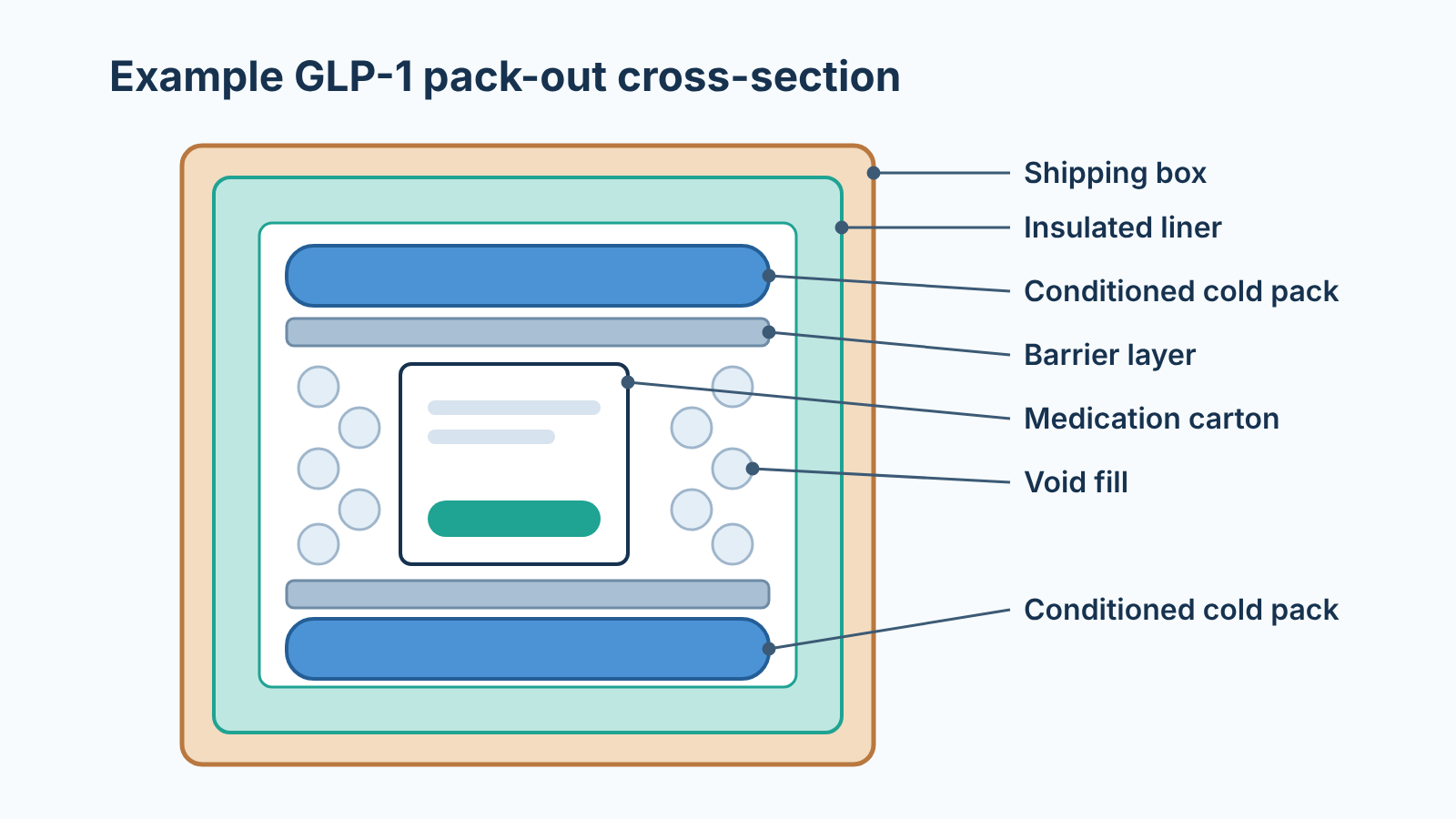
Example layout. Refrigerant type and placement vary, so follow your qualified pack-out.
6. Test against summer and winter profiles
During qualification testing, place a temperature data logger in the payload position and run the full pack-out against hot and cold conditions. See ISTA's overview of the 7E thermal standard, which provides heat and cold profiles for parcel delivery at 72 and 144 hours, based on real-world measurements. Our guide on how long ice packs stay cold in a shipping box walks through a test process.
7. Tell the patient what to do on arrival
Add a short insert: refrigerate on arrival, do not use the product if it has been frozen, and contact the pharmacy if the shipment arrives warm.
What Should You Look for in Cold Packs for GLP-1 Shipping?
The cold pack is the part of the system that does the cooling, so its consistency matters as much as the insulation. For pharmacy shipping, look at:
- Consistent weight and dimensions:
A validated pack-out assumes every pack has the same thermal mass and footprint. Ask for the tolerances. - Flatness and box fit:
Flat packs sit evenly against the liner or barrier, which helps avoid cold spots and wasted space. - Clean, leak-resistant film:
A pack that leaks can wet the medication carton, labels and patient instructions. Ask how seals are tested and what lot traceability looks like. - Contents the patient can handle:
Patients are left with the packs. Water-only packs can be drained after use, while gel disposal depends on the formulation and local rules. - Pallet configuration and freezing:
How packs arrive affects freezer loading, freezing time and how quickly the pack station can pick them. - Private-label printing:
Printed packs can carry pharmacy branding or a short handling message.
Do Gel Packs Keep GLP-1 Shipments Colder Than Water Packs?
Gel packs are not automatically better at cooling. In both gel and water packs, the cooling comes from water absorbing heat as the ice melts, so the gelling agent mainly changes how the contents look and behave.
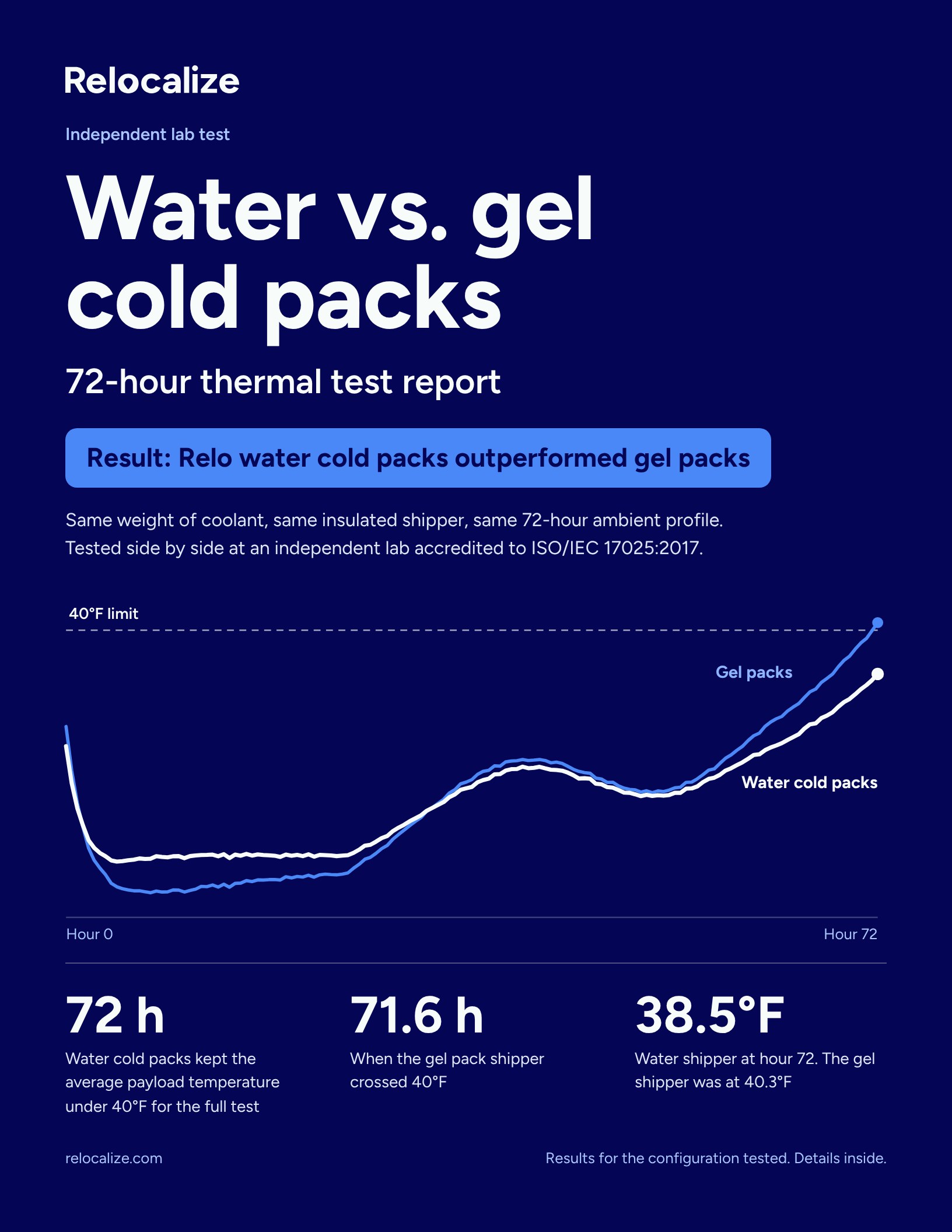
In one specific 72-hour test configuration in meal kit packaging, Relocalize water packs stayed within the protective temperature window longer than conventional gel packs before crossing 4°C. Testing was done by an A2LA-accredited laboratory under ISO/IEC 17025:2017. That test used food packaging, so a GLP-1 pack-out still needs its own qualification on your lanes. You can request the full lab report, with the temperature data, here.
Questions to Ask Your Cold Pack Supplier
- What are the weight and dimension tolerances for each pack?
- What is inside the pack, and what is the film made of?
- How are seals tested, and how are lots traced?
- How are packs configured on the pallet, and how long do they take to freeze in our freezers?
- Can you supply consistent samples for pack-out testing?
- What is the lead time, and how much buffer inventory will we need?
- Can packs be printed with our brand or handling instructions?
The Hidden Cost in Cold Pack Supply
For a direct-to-patient pharmacy, cold packs are a high-volume consumable, and their cost goes beyond the price per pack. Frozen packs are often trucked long distances, moved between cold storage sites and held as buffer stock, and each step adds freight, freezer space and handling. Supplier lead times also decide how much inventory the team has to carry ahead of demand spikes.

Where Relocalize Fits
Relocalize makes 100% water cold packs with no gel, additives or colouring, sealed in food-grade film. Weights, dimensions, formats and private-label printing can be customized to match a validated pack-out, and Relocalize works with a network of cold chain packaging partners on boxes, liners and pack-out configurations. Learn more on our direct-to-patient pharmaceutical cold chain page.
For qualifying high-volume operations, an on-site autonomous micro-factory can produce, freeze and palletize packs at or near the fulfillment center, reducing long-distance frozen-pack transport, cold storage transfers, buffer inventory and supplier lead times. Relocalize manages installation, monitoring, maintenance and production support, so customers do not buy or operate their own production line.
Key Takeaways: Does GLP-1 Need to Be Refrigerated in Transit?
Does GLP-1 need to be refrigerated during shipping? For most injectable products, yes: hold 2°C to 8°C (36°F to 46°F), never let the product freeze, and follow the label for the market you ship into. Oral tablets are the exception, with room-temperature storage.
The pack-out is what makes that happen: the right insulation, conditioned and consistent cold packs, a barrier where testing calls for one, and testing against summer and winter profiles. Explore our water cold packs, or get in touch to talk through your GLP-1 pack-out.
GLP-1 Refrigeration FAQ
Does GLP-1 need to be refrigerated before first use?
Yes, for the injectable products covered here. US labels for semaglutide and tirzepatide injections, and the Canadian monograph for semaglutide, call for 2°C to 8°C (36°F to 46°F) before first use, with no freezing. Labels in other markets can differ, so always check the approved label for the product and country.
How long can a GLP-1 pen stay out of the fridge?
It depends on the product. The US semaglutide pen label allows 56 days at 15°C to 30°C (59°F to 86°F) after first use. The US tirzepatide label allows single-dose pens and vials up to 21 days total unrefrigerated, at no more than 30°C (86°F).
Can GLP-1 medications freeze during shipping?
Yes. A parcel can freeze on a cold lane, or when a cold pack straight from the freezer touches the carton. The injectable labels say not to use the product if it has been frozen, so condition packs, use a barrier where testing shows a freeze risk, and test winter conditions.
Does oral GLP-1 need to be refrigerated?
No. The US label for oral semaglutide tablets calls for storage at 20°C to 25°C (68°F to 77°F), with excursions permitted to 15°C to 30°C (59°F to 86°F), in the original bottle to protect the tablets from moisture.
What should a patient do if a GLP-1 shipment arrives warm?
The FDA recommends that patients not use any injectable GLP-1 drug that arrives warm or with insufficient refrigeration. Patients should contact the dispensing pharmacy for next steps. Shippers can print this guidance on an insert so patients know what to check on arrival.
What type of cold pack is best for shipping GLP-1 medications?
The best cold pack is one that keeps your tested pack-out at 2°C to 8°C on every lane. Look for consistent weight and dimensions, flat packs that fit the box, clean film and contents patients can dispose of easily. Validate any pack-out on your own lanes.