A customer opens a meal kit, finds blue gel smeared across a tray of chicken, and sends your support team a photo with one question: is the gel inside an ice pack toxic? Most of the time the honest answer is reassuring. It is still a question your team has to answer quickly, accurately and the same way every time.
For operations and packaging managers, the chemistry is only part of the problem. A leaked pack can also mean a wet box, product that may have warmed, a credit or reship, and a customer deciding whether to order again.
How that moment goes depends on the whole pack-out, not on the gel alone: the film and seals on the pack, how it sits in the box, how the food is wrapped, and what your documents say is inside. This guide covers what the gel is, what poison centers say about it, and how to plan for leaks.

Is the Gel Inside an Ice Pack Toxic?
The gel in most modern ice packs is considered low in toxicity. It is mostly water with a small amount of thickener, and poison centers report that a small taste typically causes mild irritation or an upset stomach at most. It is not food, though, and formulations vary, so check the safety data sheet.
Typical gel pack = water + thickener + optional additives (freeze-point depressant, preservative, dye) + plastic film
Two caveats matter for shippers. Low toxicity describes a small accidental exposure, and it does not make the gel suitable for contact with unwrapped food. And "gel pack" covers many formulations, so the reliable answer for your pack is the supplier's safety data sheet (SDS), the document that lists ingredients, hazards and first-aid measures.
What Are Gel Packs Made Of?
Gel packs are made of water, a gelling agent and a sealed plastic pouch, sometimes with a few additives.
See Poison Control's overview of what is inside an ice pack and McGill University's explainer on what ice packs are made of for the ingredients that turn up most often:
- Water:
The bulk of the pack and the part that does the cooling. - Thickener:
Often sodium polyacrylate (a super-absorbent polymer also used in diapers) or hydroxyethyl cellulose (a cellulose-based thickening agent). Some packs use silica gel. - Freeze-point depressant:
Many reusable packs contain propylene glycol, which keeps them pliable below 0°C (32°F). - Preservative:
Some packs include an agent that limits bacterial growth in the gel. - Dye:
The familiar blue color is added for appearance only. - Film:
A flexible plastic pouch, heat sealed at the edges.
Older products were a different matter. Some early reusable packs used diethylene glycol or ethylene glycol, the chemicals found in antifreeze. In 2012, the US Consumer Product Safety Commission announced a recall of about 55,000 food carriers because gel containing those chemicals could leak from damaged freezer packs. See the CPSC recall notice for freezer gel packs. Poison Control says packs of this type should no longer be available.
Do Gel Packs Cool Better Than Water Ice Packs?
Not by default. In a typical gel pack the water does the cooling. The thickener controls how the contents behave and does not add cold.
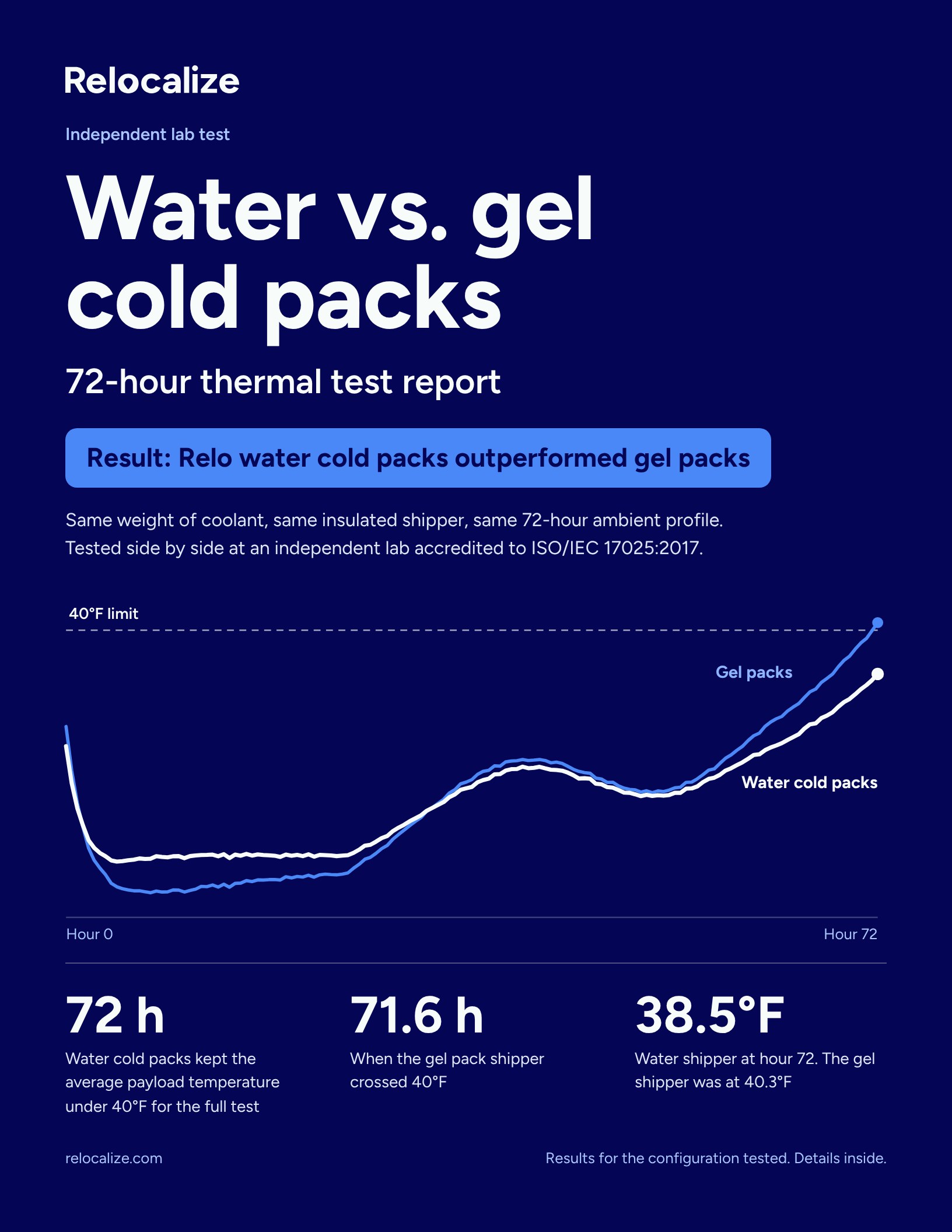
In one specific 72-hour test configuration in meal kit packaging, run by an A2LA-accredited laboratory under ISO/IEC 17025:2017, Relocalize water packs stayed within the protective temperature window longer than conventional gel packs before crossing 4°C (39.2°F).
Packs formulated to hold temperatures below 0°C (32°F) are a different product for frozen lanes. For chilled shipments, results depend on the whole pack-out, so test on your own lanes. See our guide on how long ice packs stay cold in a shipping box.
What Happens If Someone Swallows or Touches the Gel?
A small exposure to modern gel usually causes minor symptoms or none. That is the consistent message from poison centers. These two North American examples show the typical advice; elsewhere, call your local poison center.
- United States:
Poison Control says a small taste of reusable ice pack liquid typically results in mild irritation only. It advises rinsing the mouth and taking a few sips of water, and rinsing eyes with room-temperature water for 15 minutes after eye contact. Large ingestions need expert advice. Call 1-800-222-1222. - Canada:
The Ontario Poison Centre rates the poisoning risk as low, with a possible upset stomach, and suggests giving something to drink for dilution. See the Ontario Poison Centre's page on freezer packs. Other provinces have their own poison centers.
Is the Gel Inside an Ice Pack Toxic to Dogs and Cats?
It depends on the formulation, so treat any chewed pack as a reason to call a veterinarian. A "non-toxic" statement on a pack may have been written with people in mind.
Gel products are also not all alike. In September 2026, the American Animal Hospital Association reported on three dogs that developed fatal neurologic signs after eating gel cooling masks made with a polyacrylamide hydrogel. See AAHA's report on gel cooling masks and dogs. Those are not shipping packs, but the cases show why "it is only gel" is not a safe assumption.
For customer-facing copy, the advice is short: keep packs away from pets, and if one is chewed, contact a veterinarian or an animal poison control service with the product name in hand.

What Does "Non-Toxic" Mean on a Cold Pack Label?
"Non-toxic" is a marketing claim that regulators expect to be backed by evidence, and it promises less than many buyers assume. It does not mean edible, drain-safe or pet-safe.
- United States:
The FTC's Green Guides say a non-toxic claim likely conveys that a product is non-toxic both for humans and for the environment generally, and that marketers should have competent and reliable scientific evidence for it. See the FTC's guidance on non-toxic claims. - Canada:
The Competition Bureau says claims about a product's environmental benefits must be based on adequate and proper testing. See the Competition Bureau's guidance on environmental claims.
Other markets have their own rules on claims like these, so check the ones that apply where you sell. If you repeat a supplier's claim on your own insert, website or FAQ, you may be responsible for it too. Ask for the SDS and the evidence behind any "non-toxic", "food-safe" or "drain-safe" wording before you print it. Disposal is a separate question, covered in our guide on how to dispose of gel packs.
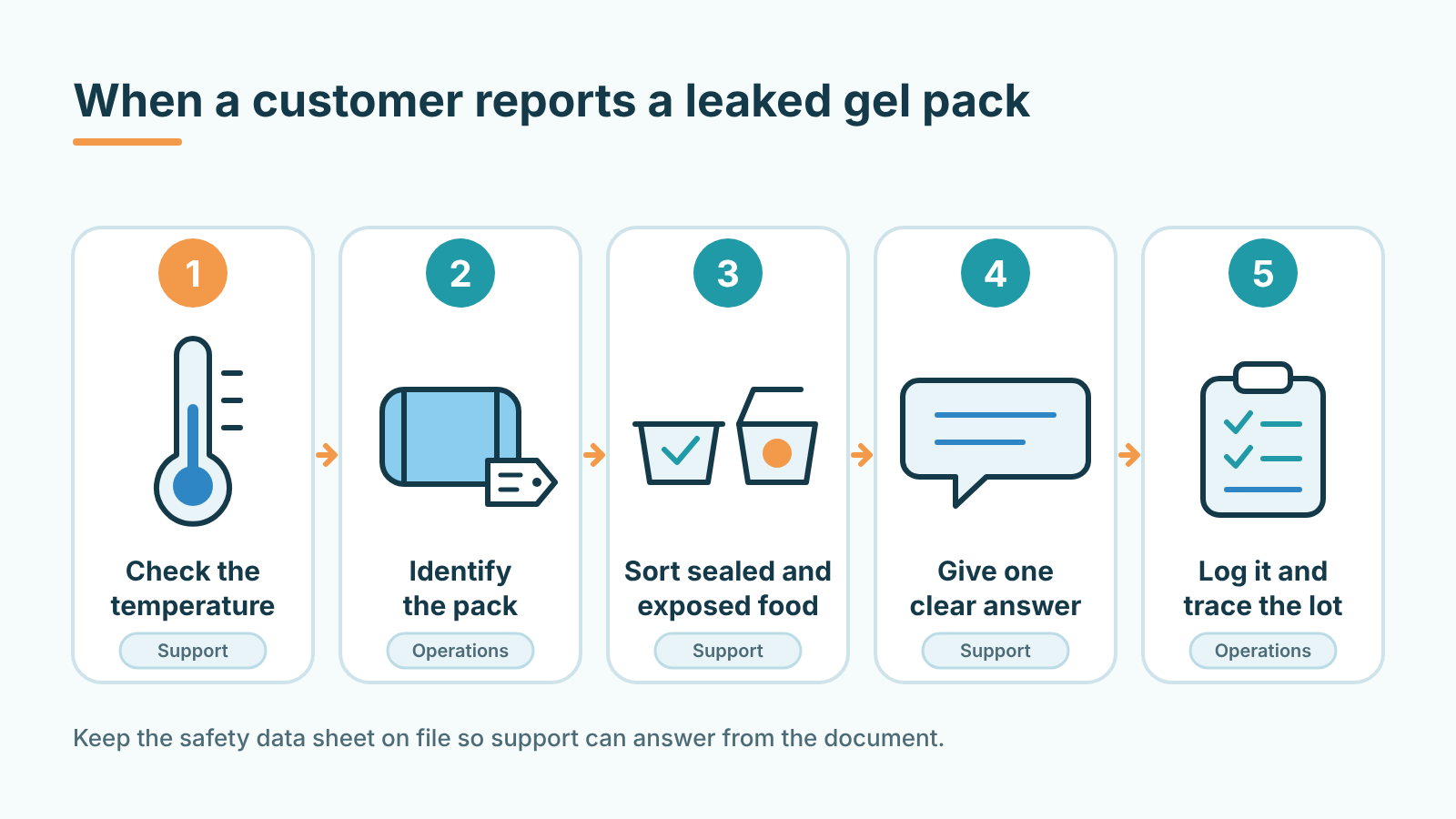
What Should Your Team Do When a Gel Pack Leaks on a Customer's Food?
Most leaks are found by the customer, who opens the box at home, sees gel on the food and contacts your support team. These steps are for you as the shipper, and they answer two questions: is the food still cold, and did the gel reach anything a person will eat?
1. Check the temperature first
Have support ask whether the food was still cold on arrival, since a leaking pack may also have cooled less. US guidance says perishable food should arrive at 40°F (4°C) or below, and that food arriving warmer should not be eaten or even tasted. See FoodSafety.gov's tips for meal kit and food delivery safety. Canadian guidance uses the same 4°C refrigeration threshold. Limits vary in other markets, so use the one that applies where you ship.
2. Identify the pack
Use the order number to find which pack, supplier and lot went into that box. Keep the current SDS on file so support can read from its first-aid section.
3. Separate sealed food from exposed food
Support applies a rule your food safety lead set in advance. A cautious version: the customer wipes gel off intact, sealed packaging, and you replace anything unwrapped, loosely wrapped or in damaged packaging that the gel touched.
4. Give the customer one clear answer
Tell them what the gel is, what to do with the affected items, and who to call with a health concern: a poison center for people, a veterinarian for pets.
5. Log it and look for patterns
Afterward, operations records the lane, pack lot, pack position and box size. Repeated leaks from the same corner of the same box size point to a pack-out problem.
A leak caught at your packing station, before the box ships, is simpler: replace the pack and anything it touched, then log it.
How Can You Reduce Leaks in Your Pack-Out?
Leak prevention is mostly mechanical: keep the film from being stressed, punctured or crushed. Review these areas, then confirm with transit testing on your own lanes.
- Film and seals:
Ask about film thickness, puncture resistance and seal width, and how seal integrity is checked during production. - Pack flatness:
A pack that freezes bulged or uneven tends to rest on its edges and seams. Flat packs spread the load across the whole face and are easier to place consistently. - Box fit:
Packs forced into a tight cavity, or sliding around in a loose one, can take more stress in transit. Match pack dimensions to the box and liner. - Sharp neighbors:
Keep packs away from tray corners, bones, clips and can rims, or add a divider.

Questions to Ask Your Cold Pack Supplier
A short set of questions covers most of what you need to know about leak risk, and what to say when a leak happens.
- What exactly is in the pack, and can you send the current SDS?
- Is the film food grade, and what documentation supports that in the markets we ship to?
- What evidence supports any non-toxic, food-safe or drain-safe claim?
- How flat do the packs freeze, and what dimensional tolerance should we design the box around?
- What should we tell a customer whose pack leaked on food, or whose dog chewed one?
- Can you trace a pack back to a production lot?
The Hidden Cost of a Leaked Gel Pack
The pack is the cheapest part of a leak. The real cost shows up in credits, reships, support time and lost repeat orders.
One leak can trigger a refund or reship, a support ticket and sometimes a public review with a photo attached. None of that appears in the price per pack, so track your own leak rate per thousand shipments next to the unit cost.
Supply plays a part as well. A conventional pack may be filled in one plant, trucked, frozen, stored, moved again and then staged at the line. Each step adds handling, which is where film can get scuffed and corners crushed.
A Different Approach: Cold Packs With Only Water Inside
One way to shorten the conversation is to take the gel out of it. Relocalize cold packs are 100% water with no gel, additives or coloring, sealed in food-grade film. Weights, dimensions and formats are customizable, and private-label printing is available. When a customer asks what is inside the pack, your support team has a one-word answer: water.
For qualifying high-volume operations, a Relocalize autonomous micro-factory can produce, freeze and palletize packs at or near the fulfillment center, reducing long-distance frozen-pack transport, cold storage transfers, buffer inventory and supplier lead times. Relocalize manages installation, monitoring, maintenance and production support, so customers do not buy or operate their own production line. It also works with a network of cold chain packaging partners on boxes, liners and pack-out configurations.
So, Is the Gel Inside an Ice Pack Toxic?
For most modern packs, the answer is no in the sense that matters to a worried customer: the gel is mostly water and considered low in toxicity. It is still not food, and it is not identical from one product to the next.
For a shipper, the more useful questions are whether you know exactly what is in your pack, whether your team can answer a leak complaint in one message, and whether your pack-out makes leaks rare.
To compare a water-only option in your own pack-out, see Relocalize cold packs and cold packs for meal kits and food fulfillment, or get in touch to talk through your configuration.
FAQ
What is the gel in ice packs?
It is water thickened with a gelling agent such as sodium polyacrylate or hydroxyethyl cellulose, sealed in a plastic pouch. Some packs also contain propylene glycol, a preservative or blue dye. The exact recipe varies by manufacturer, so the safety data sheet is the reliable reference.
Are gel ice packs toxic if a child tastes the gel?
Poison centers describe modern gel packs as low risk. A small taste typically causes mild irritation or an upset stomach at most. Rinse the mouth, give a little water, and call Poison Control at 1-800-222-1222 in the US, or your local poison center elsewhere.
Is ice pack gel toxic to dogs?
It depends on the product. Many shipping gels are low in toxicity for people, but pets can eat more relative to their size and may swallow film too. Some gel products are dangerous to dogs. Keep the packaging and call a veterinarian or an animal poison control service.
Is it safe to eat food that a gel pack leaked on?
Check temperature first: US guidance says perishable food that arrived warmer than 40°F (4°C) should not be eaten. If the food is sealed in intact packaging, the gel has not touched the food itself. For unwrapped food that touched the gel, the cautious choice is to discard it and ask the seller for a replacement.
Do gel ice packs stay cold longer than ice?
Not necessarily. In a typical gel pack the water does the cooling, so gel is not automatically the longer-lasting option. Hold time depends on pack weight, insulation, box size, pack placement and ambient temperature. Test on your own lanes.