Most teams compare insulation on one question: which material holds cold longer? That makes sense, but it leaves out the part that does the cooling. Inside every insulated shipper, the cold packs absorb the heat that gets through the walls. The insulation only slows how fast that heat arrives.
So when you weigh insulated box liners against expanded polystyrene (EPS) foam coolers, you are really choosing half of a pair. A liner that suits your box, your pack line and your customers can still fall short if the cold packs inside don't fit its cavity. A well-sized set of packs can make a modest liner work well.
This guide compares the two options on the points buyers care about: thermal performance, storage, pack line speed, protection and disposal. It then covers the step teams often skip, which is matching the cold packs to the insulation you choose.

Are Insulated Box Liners Better Than EPS Coolers?
Neither is better in every case. EPS coolers tend to suit long or hot lanes and heavy payloads, while insulated box liners often suit shorter lanes, tight storage space and fast pack lines. The right choice is the one your full pack-out passes in testing, cold packs included.
Hold time = insulation + cold packs + fit + payload + lane conditions
What Is an Insulated Box Liner?
An insulated box liner is a set of insulating panels or a pouch that fits inside a standard corrugated shipping box, turning it into a temperature-controlled shipper. Unlike a molded foam cooler, it relies on the outer box for most of its structure.
Common liner types include:
- Fiber and paper-based liners:
Made from materials such as recycled paper fiber or cotton, often chosen for curbside disposal goals. - Foil and bubble liners:
Reflective film over air cells, lightweight and compact, with performance that depends heavily on construction. - Foam sheet and film liners:
Thin foam or laminated panels that fold into the box, sitting between a flexible liner and a rigid cooler. - Plant-based and molded fiber options:
Newer materials made from starch, mycelium or other renewable inputs, with performance that varies by product.
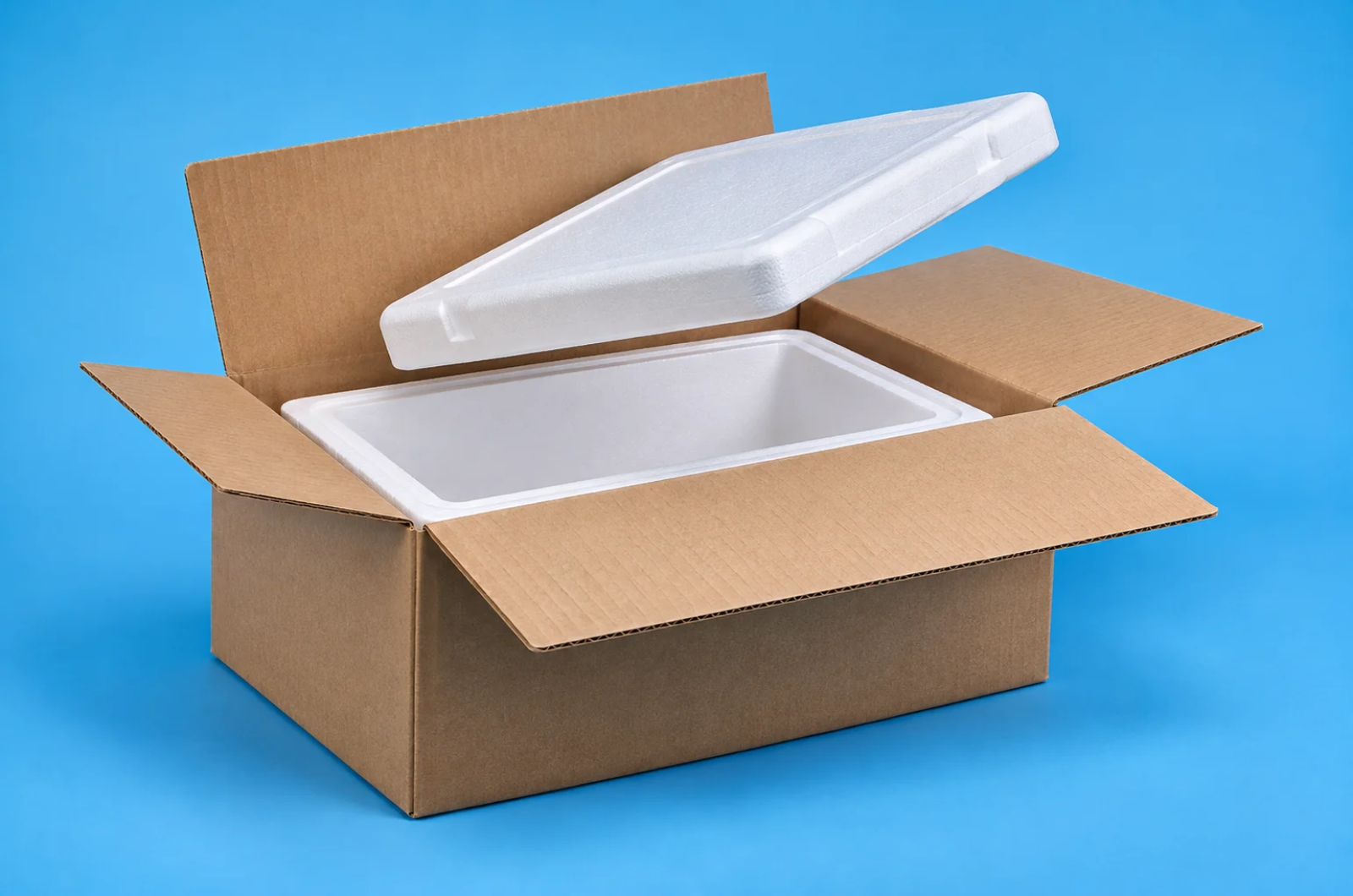
An EPS cooler is a rigid molded container, usually with a lid, that sits inside the outer box. EPS (expanded polystyrene) is a lightweight foam made of expanded plastic beads, which gives it good insulation for its weight.
Insulated Box Liners vs EPS Coolers: How They Compare
The two options differ less in how they insulate than in how they fit into your operation. Here is how they usually compare on the points that drive cost and performance.
- Thermal performance:
EPS walls are thick and rigid, which helps on long transit times and hot lanes. Liners range widely, so judge each product by its test data, not its material type. FedEx's guidance on shipping perishables calls for insulated foam containers with walls at least 1-1/2 inches (3.8 cm) thick. - Storage before use:
Many liners ship flat or compressed, so a pallet of liners can take less warehouse space than a pallet of molded coolers. Rigid coolers take up their full volume from the day they arrive. - Pack line speed:
A cooler drops into the box in one motion. A liner may need folding or several panels, which can slow packers until they are trained and the setup is tuned. - Product protection:
EPS adds rigidity and cushioning. Liners rely more on the outer box, so heavy or fragile products may need extra support. - Box size and shipping cost:
Thinner walls can mean a smaller outer box for the same payload, which may lower dimensional weight charges. Check this against the extra cold packs a thinner wall might need. - End-of-life and EPR:
Disposal options differ by material and by where your customers live. Extended producer responsibility (EPR) rules can put the cost of packaging waste on the brand that ships it.
How Do You Choose Between a Liner and an EPS Cooler?
Start from your temperature target and shipping lanes, then work through fit, operations and disposal before you test. This order keeps you from choosing a material first and fixing the pack-out around it later.
1. Set the temperature target and the lanes
Write down the range your product must stay in, the longest transit time you plan for and the hottest and coldest seasons on each lane. A two-day summer lane and an overnight winter lane can need very different insulation. Relocalize's guide to how long ice packs stay cold in a shipping box covers the factors behind hold time.
2. Measure the inner cavity, not just the box
Insulation takes space. Two shippers with the same outer box can have very different usable volume depending on wall thickness. Record the inner length, width and depth, because that is where the product and cold packs have to fit.
3. Check storage space and pack line steps
Count how many units you need on hand, how they arrive and how long each takes to assemble. A liner that saves storage space but adds a step on every order may not save money overall.
4. Check disposal rules where your customers live
Rules differ by market. In the United States, California's SB 54 packaging EPR program makes producers responsible for single-use packaging and sets 2032 targets, and CalRecycle reports that EPS food service ware currently cannot be sold in the state because a recycling benchmark was not met. In Canada, Ontario's Blue Box regulation makes producers pay for collecting and recycling the packaging they supply. Other markets have their own rules, so check each region you ship to. If you plan to call a liner recyclable or compostable in the US, review the FTC's Green Guides on environmental marketing claims first.
5. Test the full pack-out
Test the insulation and cold packs together, with real product, in the conditions of your lanes. ISTA's 7E standard sets temperature profiles for thermal packaging shipped by parcel, and ASTM D3103 covers the thermal insulation performance of distribution packages. Retest when any part of the pack-out changes.

How to Fit Cold Packs to the Liner You Already Use
The best cold packs for your liner are the ones sized to its inner cavity, placed where heat enters and flat enough to sit tight against the walls. Many operations keep their current liner and get better results by changing the packs instead.
- Size packs to the cavity:
A pack that matches the inner length and width covers the product without leaving channels of warm air around the edges. - Keep packs flat:
Flat packs sit evenly against the liner walls and the product, and they stack cleanly. Bowed or lumpy packs leave air gaps and take up more pack-out volume. - Place packs where heat gets in:
Top placement is common because warm air rises and lids are often the weakest point. Some lanes also need packs on the bottom or sides. Let testing decide. - Match weight to the lane:
Several thinner packs can fit a slim liner better than one heavy block. A heavier summer setup and a lighter winter setup can both use the same liner. - Think about cleanliness:
The cold pack's film and fill matter to the people who unpack your box. Food-grade film and a simple fill make the pack easier to explain to customers.

Does Changing Your Liner Mean Changing Your Cold Packs?
Often, yes. A new liner can change the inner cavity, the wall's heat flow and the space left for packs, so the old pack size and count may no longer fit or may no longer be enough.
The reverse also works. Before switching insulation, it is worth checking whether better-fitting cold packs solve the problem in the liner you already stock. That can avoid new tooling, new storage plans and retraining your pack line.
Questions to Ask Before You Change Liners or Cold Packs
Use this checklist with your insulation and cold pack suppliers:
- What inner cavity dimensions does this liner or cooler leave?
- What test data do you have, and under which temperature profile and payload?
- How does the liner arrive, and how much storage does a month of volume take?
- How many steps does assembly add per order on our line?
- What disposal guidance applies in each market we ship to?
- Can the cold packs be made in custom dimensions and weights to fit this cavity?
- Do the cold packs stay flat after freezing, and how do they arrive on the pallet?
- Who will help us test the full pack-out, and who pays for retesting?
The Hidden Cost in Cold Pack Supply
Insulation is a one-way purchase: it arrives, it gets used, it ships out. Cold packs are different. They usually come from a distant plant, may pass through a refrigerated warehouse to be frozen, then travel in refrigerated trucks to your fulfillment center.
Every leg adds lead time, freezer space and the risk of running short when order volume jumps. When teams compare liners, these costs rarely show up, even though they shape what the pack-out really costs.
How Relocalize Fits In
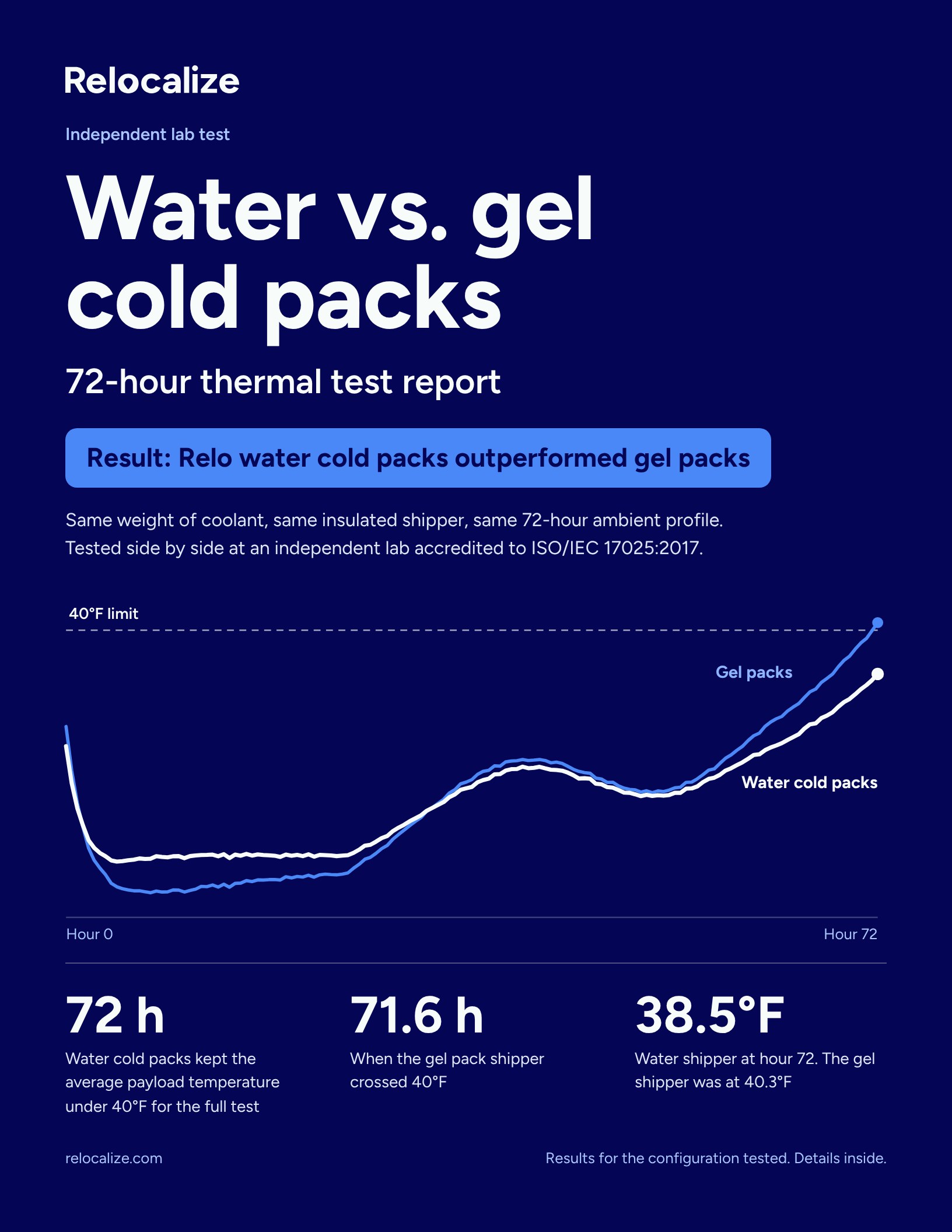
Relocalize makes cold packs filled with 100% water, with no gel, additives or colouring, sealed in food-grade film. Packs come in customizable weights, dimensions and formats, with private-label printing, so they can be sized to the liner or cooler you already use. Thanks to our unique way of making cold packs, every pack you receive is flat. Relocalize also works with a network of cold chain packaging partners on boxes, liners and pack-out configurations if you want to look at other insulation.
For qualifying high-volume operations, an on-site autonomous micro-factory can produce, freeze and palletize packs at or near the fulfillment center. That reduces long-distance frozen-pack transport, cold storage transfers, buffer inventory and supplier lead times. Relocalize manages installation, monitoring, maintenance and production support. Learn more about cold packs for meal kits and food fulfillment.
So, Which Should You Choose: Insulated Box Liners or EPS Coolers?
Choose the option your operation can store, pack and dispose of easily, then prove it with the cold packs you will actually ship. Insulated box liners and EPS coolers can both work well. What usually decides performance is how well the cold packs fit the space the insulation leaves.
If you are reviewing your pack-out, see Relocalize's buyer's checklist for cold chain packaging, or get in touch with Ben and our packaging team. We can look at your current liner and cold packs together, and testing can be arranged on request.
FAQ
What are insulated box liners used for?
Insulated box liners turn a standard corrugated shipping box into a temperature-controlled shipper. They are used for meal kits, fresh food, beverages, pharmaceuticals and other products that must stay within a set temperature range. They work together with cold packs, which absorb the heat that passes through the liner.
Are insulated box liners as good as EPS coolers?
It depends on the lane and the payload. EPS coolers often suit long or hot lanes and heavy products, while many liners perform well on shorter lanes and save storage space. Compare test data for your own pack-out rather than relying on the material type alone.
How do I choose the right size of insulated box liner?
Start from the inner cavity you need, not the outer box. Add up the product dimensions and the space for cold packs, then choose a liner whose inner dimensions fit both closely. Too much empty space gives the cold packs more air to cool and can shorten hold time.
Do insulated box liners need cold packs?
Yes, for most chilled and frozen shipments. A liner slows heat moving into the box, but it does not remove heat on its own. Cold packs absorb that heat, so the liner and the packs need to be sized and tested together for each lane and season.
Can I keep my current liner and change only my cold packs?
Often, yes. Cold packs sized to the liner's inner cavity, kept flat and placed where heat enters can improve a pack-out without changing the insulation. Test the new setup with real product before you scale it, and retest when seasons change.
Are insulated box liners recyclable?
Some are, depending on the material and on local collection programs. Paper and fiber liners are often designed for curbside recycling, while foam and film liners may need special handling. Check guidance in each market you ship to, and follow your local waste management rules.