Ask a packing team how long does it take an ice pack to freeze and the usual answer is "overnight." For one pack lying flat in an empty freezer, that can be close. For a fulfillment center that needs thousands of fully frozen packs at the line every morning, overnight is rarely the real answer.
In a typical cold pack supply chain, packs are filled and sealed at a plant, sent by ambient truck to a third-party refrigerated warehouse that freezes them to the customer's order, then shipped by refrigerated truck to the fulfillment center. In that warehouse, the cold air of a storage room does the freezing, slowly, from the outside of each pallet in.
So in conventional freezing, freeze time depends on the whole system: the pack's size, how packs are stacked, the room's temperature and airflow, and how much warm product goes in at once. This guide covers each factor, why cold storage struggles to freeze at volume, and what the waiting really costs.

How Long Does It Take an Ice Pack to Freeze?
With conventional freezing, a single ice pack laid flat in a freezer at -18°C (0°F) or colder needs 24 to 48 hours to freeze fully, according to one supplier's instructions. A full pallet takes far longer: another supplier advises at least 21 days. Pack size, spacing, airflow and freezer load set the real time.
Freeze time = heat to remove (pack weight, starting temperature) ÷ rate the freezer can remove it (air temperature, airflow, spacing, pack thickness)
See Polar Tech's freezing instructions for gel packs, which allow 24 to 48 hours and note that the time depends on pack size and freezer load, and Pelton Shepherd's tips for freezing gel packs, which call for a minimum of 21 days for a full pallet. Both are guidelines for those suppliers' own products, so confirm freeze time for your packs by checking packs from the center of the load.
What Affects How Long Ice Packs Take to Freeze?
In conventional freezing, five factors decide most of the freeze time: pack thickness, freezer temperature, airflow and spacing, starting temperature, and how much the freezer is asked to freeze at once.
Water has to give up a lot of heat to become ice. Turning 1 gram of water at 0°C (32°F) into ice removes about 80 calories, roughly 80 times the heat needed to change that gram's temperature by 1°C. See Penn State's explanation of latent heat and freezing. That hidden heat, called latent heat, is why freezing takes time.
FAO's guidance on freezing time, written for food freezing, explains how each factor plays out:
- Pack thickness and shape:
Thicker packs take disproportionately longer. FAO notes that for thicker products, doubling the thickness can more than double the freezing time. A flat, even pack freezes faster and more uniformly than a bulged one. - Freezer temperature:
The colder the air, the faster heat leaves the pack. US guidance treats -18°C (0°F) or below as the standard for frozen storage. See FoodSafety.gov's cold food storage chart. Other markets publish their own guidance. - Airflow and spacing:
Moving air carries heat away, so freezing time drops as air speed rises. Packs stacked tight with no gaps behave like one large block. - Starting temperature:
Warmer packs take longer. Pre-chilling packs cuts both freeze time and the load on the freezer. - Freezer load and wrapping:
Trapped air insulates. In one FAO example, removing the lid from a cardboard box of product cut its freezing time from 15 hours to 8.
Why Is Freezing Cold Packs in Cold Storage So Slow?
Because keeping things cold and making things cold are different jobs. A cold storage room is built to hold product that is already cold at a steady temperature. Freezing hundreds of pallets of packs from room temperature asks it to remove far more heat, far faster.
FAO's guidance on cold store equipment notes that freezers require a much larger refrigeration capacity than the store they serve, and advises against loading warm produce into a store. Its guide to freezers adds that a single fillet can take 4 times as long to freeze in the still air of a cold store as in a properly designed air blast freezer, and that loading too much product at once will overload the refrigeration plant.
For cold packs, that means:
- Capacity limits:
How many packs a site can freeze per day depends on how its refrigeration was designed and sized, not only on floor space. - Overload risk:
Loading too many unfrozen pallets at once can overload the refrigeration plant, and the room's temperature can rise for everything inside.
Is Gel Better Than Water for Cooling Performance?
Not automatically. In a typical gel pack, the water does the cooling. Many reusable gel packs also contain an ingredient, usually propylene glycol, that lowers the freezing temperature, according to Poison Control's overview of what is inside ice packs, so they may need a colder freezer to go solid.
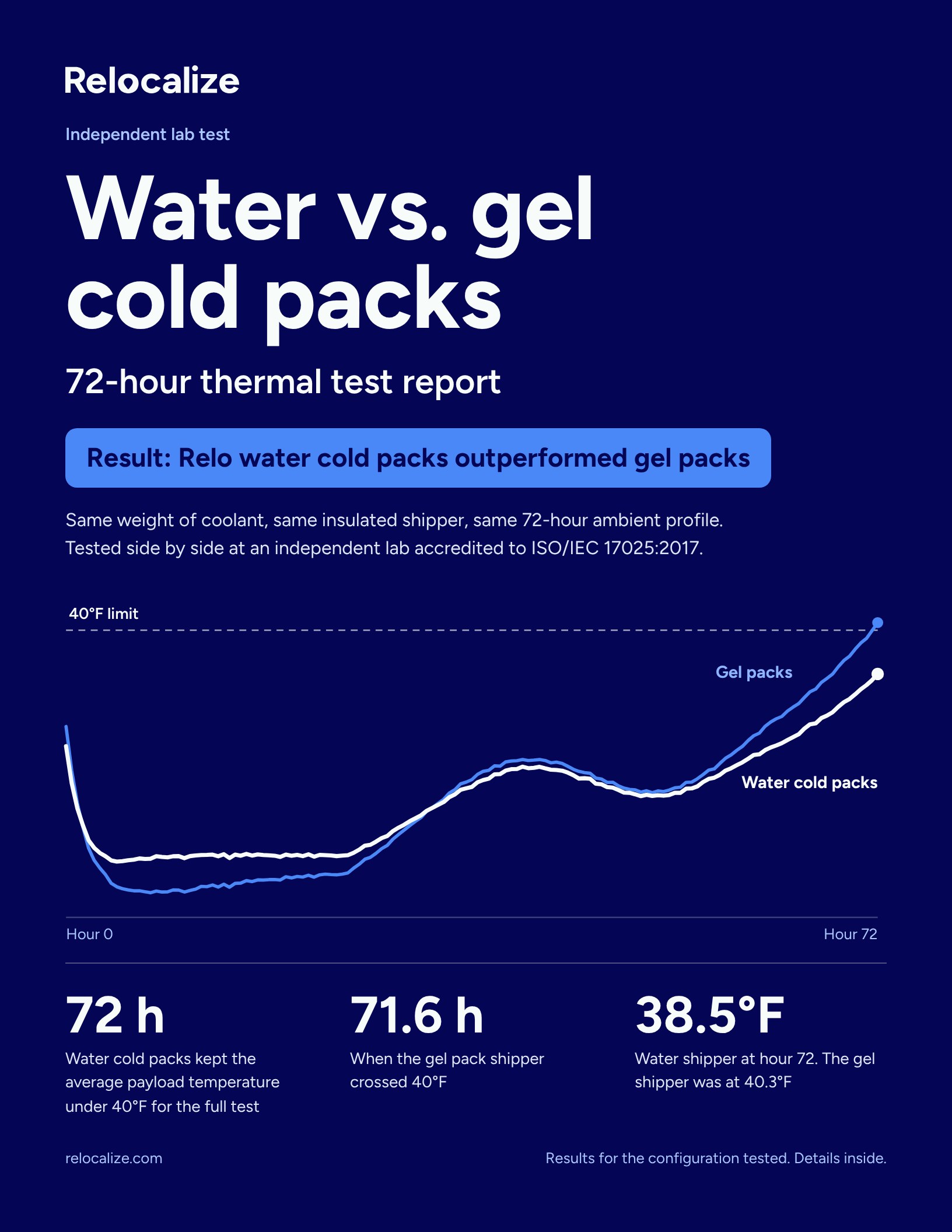
In one specific 72-hour test configuration in meal kit packaging, run by an A2LA-accredited laboratory under ISO/IEC 17025:2017, Relocalize water packs stayed within the protective temperature window longer than conventional gel packs before crossing 4°C (39.2°F). That result applies to that configuration, so test any pack in your own pack-out and lanes. Our guide on how long ice packs stay cold in a shipping box walks through that test process.
You can request the full lab report, with the temperature data, here.
How Long Does a Full Pallet of Ice Packs Take to Freeze?
In a conventional cold storage room, it can take weeks rather than hours, because the packs in the middle of a pallet are insulated by every pack around them. Pelton Shepherd's guidance for its own gel packs calls for at least 21 days for a full pallet.

A pallet freezes from the outside in, so one that feels rock solid on its faces can still have packs in the center that slosh.
Freezing is also only one part of a longer lead time. Packs travel by ambient truck to the cold storage provider, wait their turn to be frozen, then travel by refrigerated truck to the fulfillment center. Relocalize maps the full cycle, from placing an order to receiving the frozen cold packs, at 32 to 53 days, with two truck trips and four handoffs. See the breakdown on our direct-to-patient pharmaceutical cold chain page.
Why Are Conventional Cold Packs Frozen in Boxes?
In conventional freezing, packs are loaded into corrugated cases and the cases are stacked on pallets before they go into cold storage. The case is more than shipping packaging: it also acts as the mold that gives each pack its shape and flatness as it freezes.
That approach creates its own problems:
- Cases slow the freeze:
Cardboard and trapped air insulate each pack, as FAO's box-lid example above shows. - Cases have to be opened by hand:
Because the case is part of the freezing process, it cannot be removed before delivery. Some direct-to-consumer operators tell us they assign staff just to open cases and pull packs for the line. - No quality check after freezing:
Once packs are frozen inside closed cases, nobody sees them until the pack-out line. A pack that froze bulged, wedged or out of shape is found there, and the only option is to discard it. - Cases weaken when they move between temperatures:
Frozen cases pick up condensation when they move into warmer, humid air. The Association of Independent Corrugated Converters notes that moving boxes between temperature zones can cause condensation that weakens the board, and that stacking strength can fall to about 50% above 85% relative humidity. See AICC's guidance on corrugated packaging in cold conditions. A crushed case can deform the packs inside it. - Cardboard to break down:
Every case becomes waste at the fulfillment center.
How to Freeze Ice Packs Faster in Conventional Cold Storage
Whether packs are frozen by a cold storage provider or in your own freezer, most gains come from giving cold air access to every pack and not asking the refrigeration to do too much at once.
1. Lay packs flat and avoid deep stacks
Polar Tech's instructions note that stacking too deeply slows the freeze. Pelton Shepherd recommends leaving about 2.5 cm (1 inch) between packs or cases.
2. Build air channels into pallets
Use spacers or open layers so air moves through the load, not only around it.
3. Pre-chill and stagger loading
Packs that start cold put less heat into the room. Add warm pallets in batches so the refrigeration can hold its set point.
4. Check the core, not the surface
Test packs from the center of the pallet. Polar Tech advises verifying that packs are solid before use: any slosh means they are not ready.
Questions to Ask Your Cold Pack Supplier About Freezing
A few questions show how much of this work falls on you:
- Are packs frozen as part of production, or frozen later in cold storage?
- Are packs frozen inside cases, and who opens them?
- How are packs checked for shape and flatness after freezing?
- If our volume jumps, how quickly can you deliver more frozen packs?
- What is the lead time from order to frozen packs at our line?
The Hidden Cost of the Conventional Cold Pack Supply Chain
When packs are frozen by a third party and trucked in, the waiting becomes a cost that never shows up in the price per pack.
- Little room for buffer stock:
Many direct-to-consumer fulfillment centers we speak with have limited space to store cold packs, so frozen packs keep arriving as stock runs down. - Long lead time:
With ambient trucking, third-party freezing and refrigerated delivery, a new order takes weeks to reach the line. - Little room for surprises:
If volume spikes or a delivery slips, the supply chain may not keep up, and there is no quick way to get more frozen packs.
A Different Approach: Cold Packs Produced Frozen
Relocalize makes cold packs differently. Instead of manufacturing packs, trucking them to cold storage and freezing them there, an autonomous RELO micro-factory fills, seals and freezes each pack in one automated, sensor-monitored process. With no separate freezing step and no trucking between plant, cold storage and fulfillment center, the time from production to delivery is significantly shorter.

For qualifying high-volume operations, the micro-factory produces, freezes and palletizes packs at or near the fulfillment center, reducing long-distance frozen-pack transport, cold storage transfers, buffer inventory and supplier lead times. Relocalize manages installation, monitoring, maintenance and production support, so customers do not buy or operate their own production line.
The packs are 100% water with no gel, additives or coloring, sealed in food-grade film, with customizable weights, dimensions, formats and private-label printing. Relocalize also works with cold chain packaging partners on boxes, liners and pack-out configurations. See how the Relocalize technology works.
So, How Long Does It Take an Ice Pack to Freeze?
With conventional cold storage freezing, supplier guidance points to a day or two for one pack and weeks for a full pallet. In practice, how long it takes an ice pack to freeze is set less by the pack than by refrigeration built to keep things cold, not to make them cold.
If lead times, buffer stock or case handling are shaping your pack-out, compare Relocalize cold packs with your current supply, or get in touch to talk through your volumes.
FAQ
How long do ice packs take to freeze in a regular freezer?
Supplier instructions commonly allow 24 to 48 hours for a single pack laid flat at -18°C (0°F) or colder. Thicker packs, a crowded freezer or packs stacked together take longer. Check that the pack is solid all the way through before using it.
How long do gel ice packs take to freeze?
It depends on the formulation. Many reusable gel packs contain propylene glycol to lower the freezing point, so they may need a colder freezer or more time than a water pack of the same size. Follow the freezing temperature and time on the supplier's spec sheet.
How long does it take an ice pack to freeze on a pallet?
In conventional cold storage, much longer than a single pack, because center packs are insulated by the packs around them. One supplier advises at least 21 days for a full pallet of its gel packs. Spacing, airflow and freezer temperature all change the result.
Can a cold storage room freeze cold packs quickly?
Not usually at volume. Cold storage rooms are built to keep frozen product cold, and freezing needs much more refrigeration capacity. Loading many warm pallets at once can overload the system and raise the room's temperature for everything stored inside.
How do I know if an ice pack is fully frozen?
Check packs from the middle of the load, not just the outside. A fully frozen pack is solid with no slosh or soft spots. On a pallet, the center packs freeze last, so test them before releasing the pallet to the line.