Ambient temperature is the temperature of the surrounding air or environment. In cold chain and supply chain logistics, it usually refers to the temperature surrounding a product, package, pallet, vehicle, or storage area.
That is different from the temperature of the product itself.
For example, a pharmaceutical shipment may need to remain between 2°C and 8°C while traveling through an environment where the ambient temperature is 30°C. A meal kit may leave a refrigerated fulfillment center and spend several hours inside a delivery vehicle on a hot summer day.
In both cases, the surrounding ambient temperature affects how difficult it is to maintain the required temperature inside the package.
Understanding ambient conditions is therefore an important part of cold chain packaging, transportation, and supply chain planning.
What Does Ambient Temperature Mean?
In simple terms, ambient temperature means the temperature of the environment surrounding an object.
It does not always mean room temperature.
For example, the ambient temperature surrounding a shipment could be:
- 22°C inside a warehouse
- 35°C inside a delivery vehicle during summer
- Below 0°C on a loading dock during winter
This is why there is no single temperature that universally defines “ambient.”
In logistics, the word may also be used to describe products that do not require refrigeration or freezing. However, some products must still remain within a specified controlled ambient temperature range.
The required conditions always depend on the product being transported or stored.

What Does Ambient Mean in Cold Chain and Supply Chain Logistics?
In the supply chain, ambient temperature refers to the temperature surrounding goods as they move through warehouses, distribution centers, trucks, loading areas, sorting facilities, and other logistics environments.
In the cold chain, ambient temperature is especially important because temperature-sensitive products must remain within a specified range even when the environment around them is much hotter or colder.
Consider a medication that must stay refrigerated between 2°C and 8°C.
The product may need to remain within this temperature range while the shipping box around it is exposed to an ambient environment of 25°C, 30°C, or even higher.
The insulated packaging, cold packs, and packout configuration are designed to protect the product from those external conditions.
The greater the difference between the required product temperature and the ambient environment, the more thermal protection may be required.
Ambient vs. Room Temperature vs. Refrigerated vs. Frozen
These terms are related, but they are not interchangeable.
The exact required range depends on the product.
Food, pharmaceuticals, biologics, laboratory samples, beverages, meal kits, and other temperature-sensitive products may all have different storage and transportation requirements.
Is ambient temperature the same as room temperature?
Not exactly.
Room temperature generally refers to a relatively stable indoor environment.
Ambient temperature simply means the actual temperature surrounding a product or shipment.
For example, the inside of an unconditioned delivery van on a summer afternoon may reach well above normal room temperature. That temperature is still the shipment's ambient environment.
For cold chain operations, this distinction matters because shipments often move through many different environments before reaching the final customer.
Why Does Ambient Temperature Matter in Cold Chain Shipping?
Cold chain packaging is designed to reduce heat transfer between the product and the environment around it.
That means the surrounding ambient temperature directly affects how hard the packaging system must work.
Imagine two identical insulated boxes containing the same product and cold packs.
One travels through a mild 20°C environment.
The other spends several hours inside a delivery vehicle during a 35°C summer day.
Even though the box, product, insulation, and cold packs are identical, the second shipment experiences a much greater thermal load.
This is why cold chain packaging cannot be designed based only on the desired product temperature.
Other important factors include:
- Expected ambient temperature
- Shipment duration
- Geographic location
- Season
- Transportation method
- Product mass
- Insulation performance
- Cold pack quantity and placement
- Required product temperature range
A packaging configuration that performs well in spring may behave very differently during extreme summer heat or winter cold.
How Does Ambient Temperature Affect Cold Chain Packaging?
A typical cold chain package may include an outer shipping box, insulation, a temperature-sensitive product, and cold packs or another refrigerant.
Together, these components create a thermal barrier between the product and the surrounding environment.
The appropriate configuration depends on the application.
For example, a pharmaceutical shipment traveling for 48 hours through a hot climate may require a different packout than a food shipment traveling overnight in mild weather.
Adding more cold packs is not automatically the best solution either.
Too little cooling can allow the product to become too warm, while too much or poorly positioned coolant may expose freeze-sensitive products to temperatures that are too cold.
This is why cold chain packaging is often tested and configured around specific shipping conditions.
The goal is not simply to make the package cold. The goal is to keep the product within its required temperature range for the entire shipping period.
Ambient Temperature in Pharmaceutical and Food Supply Chains
Ambient temperature is particularly important in pharmaceutical logistics because many medicines must remain within defined temperature ranges during storage and transportation.
Some pharmaceutical products can be shipped under controlled ambient conditions.
Others—including many biologics, injectable medications, vaccines, and specialty pharmaceuticals—may require refrigerated or frozen transportation.
For direct-to-patient pharmaceutical delivery, ambient conditions can be especially challenging because packages may move through multiple uncontrolled environments before reaching the patient.
A shipment may pass through:
- A temperature-controlled fulfillment center
- A loading dock
- A parcel carrier facility
- A transportation hub
- A delivery vehicle
- A customer's doorstep
Each environment can expose the shipment to different ambient temperatures.
The same principle applies to food and beverage shipments.
Meal kits, seafood, dairy products, fresh beverages, meat, produce, and other perishables may require insulated packaging and cold packs to maintain product quality throughout delivery.
Why Seasonal Ambient Conditions Matter
Ambient temperatures can change dramatically by season and geography.
A shipping configuration that performs well in March may face very different conditions in July.
The same package shipped from a fulfillment center in the Northeast may also encounter very different conditions from one shipped across the Southern United States.
That means businesses should consider the complete shipping lane when evaluating cold chain packaging.
Important questions include:
- Where is the shipment starting?
- Where could it be delivered?
- How long will it remain in transit?
- What temperatures could it encounter?
- Will it spend time in an uncontrolled vehicle or facility?
- Could the package sit outside after delivery?
Understanding these conditions helps businesses choose more appropriate insulation, refrigerant quantities, and packout configurations.
How Cold Packs Help Protect Products From Ambient Conditions
Cold packs help absorb heat entering a package from the surrounding environment.
When used with the right insulation and packaging design, they can help maintain refrigerated conditions for temperature-sensitive products during transportation.
However, cold packs are only one part of the system.
Their size, weight, placement, quantity, and starting temperature can all affect performance.
A well-designed packout should consider the entire system:
Product + cold packs + insulation + shipping box + transit time + ambient conditions.
For high-volume fulfillment operations, another consideration is how frozen cold packs are supplied to the packing line.
Cold packs traditionally may need to be manufactured elsewhere, transported to a facility, frozen, stored, and managed as inventory before they are used.
That can create additional freight, cold-storage requirements, and operational complexity.
A Different Approach to Cold Pack Supply
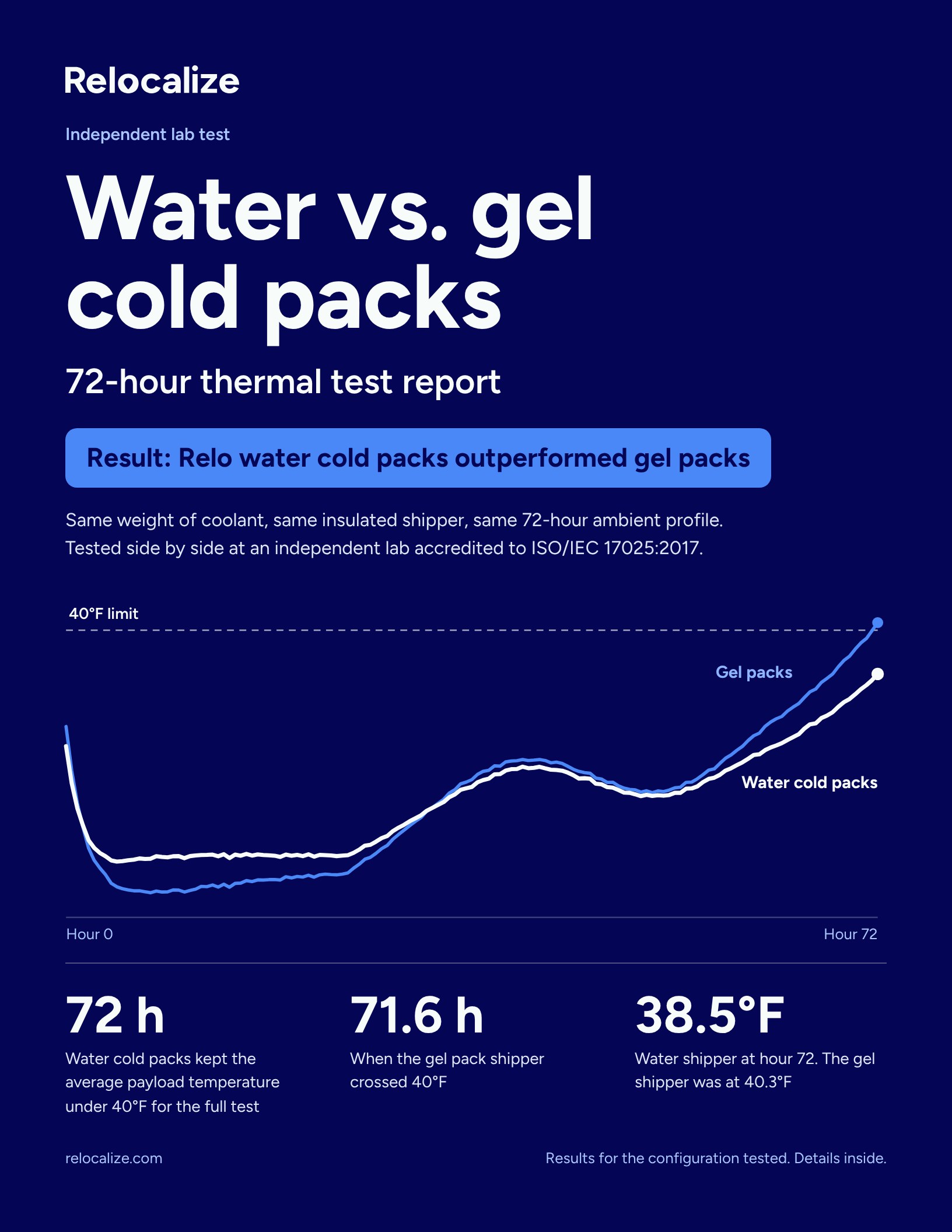
Relocalize produces water cold packs directly at high-volume fulfillment and distribution facilities using autonomous micro-factories.
Instead of shipping large quantities of cold packs through a conventional supply chain and storing them frozen until needed, cold packs can be produced and frozen closer to the packing operation.
For businesses shipping large volumes of temperature-sensitive products, this approach can help reduce:
- Cold pack transportation
- Frozen storage requirements
- Inventory complexity
- Dependence on external frozen cold pack deliveries
Relocalize cold packs are 100% water-based and can be customized in different sizes, weights, and formats to support different cold chain packaging configurations.
For pharmaceutical, food, meal kit, and other cold chain fulfillment operations, onsite cold pack production can become part of a broader strategy to simplify temperature-controlled shipping.
Build Cold Chain Packaging Around Real-World Conditions
Ambient temperature may sound like a simple measurement, but it can have a major impact on cold chain performance. The right packaging configuration depends on more than whether a product should be ambient, refrigerated, or frozen. Transit time, season, shipping lane, insulation, cold packs, packout design, and expected ambient conditions all work together.
Relocalize helps high-volume fulfillment operations simplify one part of that system with customizable water cold packs and onsite cold pack production. Explore Relocalize cold chain solutions to learn how cold packs can be produced closer to where they are used.
Frequently Asked Questions About Ambient Temperature
What is ambient temperature in cold chain logistics?
Ambient temperature is the temperature of the environment surrounding a cold chain product or package. The product itself may need to remain refrigerated or frozen even when the ambient environment around the package is much warmer.
What is ambient temperature in the supply chain?
In the supply chain, ambient temperature refers to the surrounding environmental temperature goods experience during storage, transportation, handling, and delivery.
What temperature is considered ambient?
There is no single universal ambient temperature. Ambient simply means the temperature of the surrounding environment. Specific controlled ambient ranges depend on the product and its storage requirements.
What does ambient mean in shipping?
Ambient shipping generally refers to transporting products without refrigerated or frozen temperature control. However, products may still have specific allowable temperature ranges.
Is ambient temperature the same as room temperature?
No. Room temperature generally describes a comfortable indoor range, while ambient temperature describes the actual surrounding environmental temperature wherever the product is located.
Why is ambient temperature important in cold chain packaging?
Ambient temperature affects the amount of heat entering or leaving a package. It therefore influences the insulation, cold pack quantity, packout design, and thermal performance required to protect temperature-sensitive products.